

Table of Contents
Fake investment agents aggressively target NRIs because they understand exactly how NRI wealth management works — and precisely where the gaps are. Remote management of Indian assets, dependence on digital communication, limited visibility into current SEBI and RBI regulations, and a genuine desire for a trusted financial contact in India. These are not weaknesses — they are the realities of managing money across borders. But they are also the entry points fraud networks have specifically studied and built their playbooks around. If you follow three rules — verify identity, verify process, verify payment destination — you eliminate almost all exposure to this fraud.
3 Checks
Expose almost every fake investment agent
10 Red Flags
Any single one is enough to disengage
5 Minutes
To verify any agent before committing money
Here’s what makes investment fraud against NRIs particularly effective: it doesn’t feel like fraud while it’s happening. The documents look professional. The agent sounds knowledgeable about Indian markets. They understand your situation — managing money from a distance, wanting to support family, missing the day-to-day context of regulatory changes back home. That understanding is genuine. It’s also exactly what makes the pitch work.
This guide gives you everything you need: the three checks that expose almost any fake agent in under five minutes, the ten red flags that are individually conclusive, a five-step verification process, the four scam patterns specifically built for NRIs in 2026, the only safe channels you actually need, and a seven-step emergency protocol if you’ve already engaged with someone suspicious.
01 The Golden Rule — Three Checks That Expose Every Fake Agent
If you remember nothing else from this guide, remember this: no investment conversation should proceed past these three checks. Each one takes under two minutes, and a legitimate agent will never object to any of them.
Check 1
Go to sebi.gov.in or amfiindia.com right now, while they’re still on the call. If the name does not match exactly, stop.
Check 2
A mutual fund investment goes through an AMC portal. A PMS goes through a SEBI-registered PMS manager. No regulated investment involves WhatsApp approvals, pool accounts, or screenshot-based instructions.
Check 3
Call the AMC or broker directly on their official helpline to confirm the account number independently before any transfer.
These three checks take under five minutes combined. No legitimate agent will object to any of them. A fake agent will. If an agent pressures you to skip verification, refuses a video call, or asks for money before paperwork — any one of these is sufficient reason to disengage entirely.
02 Why NRIs Are the Primary Target for Fake Investment Agents
Fraud networks that target NRI investors are not opportunistic — they are structured operations that study NRI behaviour patterns, investment preferences, and communication channels. Understanding your specific vulnerability profile is the first step to neutralising it.
| Vulnerability | How Fraudsters Exploit It | The Protection |
|---|---|---|
| Remote management of Indian investments | NRIs cannot physically verify agents, offices, or documents. Fraudsters use this distance to avoid scrutiny | Demand video verification and cross-check all credentials on SEBI/AMFI portals before any engagement |
| Dependence on WhatsApp and phone | Fraudsters operate entirely on WhatsApp where there’s no paper trail, no KYC, and no regulatory oversight | Any agent who refuses to move to a formal, documented channel is not a legitimate agent |
| Limited awareness of current SEBI/RBI rules | Rules on NRI investment, FEMA compliance, and NRE/NRO usage change regularly. Fraudsters exploit this knowledge gap | Verify all claims about ‘special rules’ or ‘new schemes’ directly on sebi.gov.in or rbi.org.in before acting |
| Desire for a trusted contact in India | Fraudsters present themselves as helpful insiders who ‘understand the NRI situation’ and can manage things on your behalf | A trusted financial relationship requires a SEBI registration number, not just a warm personality |
| Emotional triggers around family and India | Pitches use language around preserving family wealth, supporting aging parents, or ‘investing in India’s growth story’ | Emotional resonance is not a financial credential. Verify the registration first, always |
| Higher disposable income, larger investments | NRIs investing in India typically invest larger amounts than domestic retail investors, making them more valuable targets | Set a firm rule: no investment conversation proceeds until SEBI/AMFI registration is independently verified |
The most consistently exploited vulnerability is the desire for a trusted contact in India who ‘understands the NRI situation.’ Fraudsters spend significant time building this trust before any financial ask is made. The protection is simple but requires discipline: a warm personality and apparent local knowledge are not financial credentials. SEBI registration is. Verify it first, always.
Pro Tip
03 The 10 Red Flags That Expose a Fake Investment Agent
Any single one of these ten red flags is sufficient reason to disengage immediately. You don’t need multiple signals to appear together — a fake agent may only trigger two or three of these, but each one, alone, is conclusive.
| # | Red Flag | What It Looks Like | Why It’s Always a Scam |
|---|---|---|---|
| 1 | They contacted you first | “Exclusive NRI investment window,” “Guaranteed 14–18% returns” via unsolicited WhatsApp, LinkedIn DM, or call | Legitimate SEBI-registered agents do not cold-pitch NRIs. Regulated advisers wait for clients to approach them |
| 2 | No verifiable SEBI registration | They claim to be ‘authorised partners’ but send edited PDFs, avoid sharing a registration number, or give one that doesn’t match on SEBI’s portal | Every genuine SEBI RIA and AMFI ARN holder has a public record. Verification takes under two minutes |
| 3 | Operates entirely on WhatsApp | They ask for passport scans, NRE/NRO statements, and screenshot-based approvals, routing transfers to ‘pool accounts’ via payment links | Legitimate investments never run on WhatsApp. No regulated channel accepts screenshot approvals or pool account transfers |
| 4 | Promises guaranteed returns | “18% assured monthly income plan,” “Government-backed NRI bond at 12%,” “Zero-risk PMS with guaranteed profit sharing” | No SEBI-regulated investment product offers guaranteed returns. Guaranteed returns means unregistered, and almost certainly fraudulent |
| 5 | Asks for personal/new account transfers | Money directed to a personal savings account, a newly opened current account, a UPI ID, or a payment gateway link | Legitimate investments go only to AMC accounts, broker settlement accounts, or RBI/GOI designated accounts — never to individuals |
| 6 | Refuses video verification | Prefers voice calls or WhatsApp audio and declines video calls, live display of SEBI certificates, or office premises on camera | Any agent who is genuinely registered has nothing to hide on a video call. Refusal is conclusive |
| 10 | High-pressure urgency tactics | “Last date today for NRI quota,” “Only 3 slots remaining,” “If you delay, you lose the benefit permanently” | No regulated financial institution creates artificial scarcity or time pressure. Urgency is manufactured to prevent verification |
| 8 | Polished but unverifiable documents | Fake AMC letterheads, edited SEBI circulars, fabricated portfolio statements with convincing formatting | Every official SEBI document has a verifiable reference number. Every AMC communication is verifiable through the AMC directly |
| 9 | Claims ‘special access’ to PMS/AIF | “Insider NRI-only allocation,” “Special NAV for NRI window,” capital protection or guaranteed profit sharing on PMS | No SEBI-registered PMS or AIF offers guaranteed returns, capital protection, or NRI-exclusive access not disclosed in their SEBI filing |
| 10 | Avoids formal agreements and paperwork | They want the transfer first, promising the RIA-client agreement, FATCA declaration, and onboarding documents ‘afterwards’ | Paperwork before money, always. Delaying formal agreements until after the transfer makes the transaction unrecoverable |
— guaranteed returns — deserves emphasis. The promise of guaranteed, fixed returns on any market-linked investment product — mutual fund, PMS, AIF, or equity — is not merely suspicious. It is legally impossible for a SEBI-registered entity to make this promise under Indian securities law. If an agent guarantees returns, they are either unregistered, deliberately misrepresenting a product, or operating an outright Ponzi structure. There is no legitimate interpretation.
Red flag 4
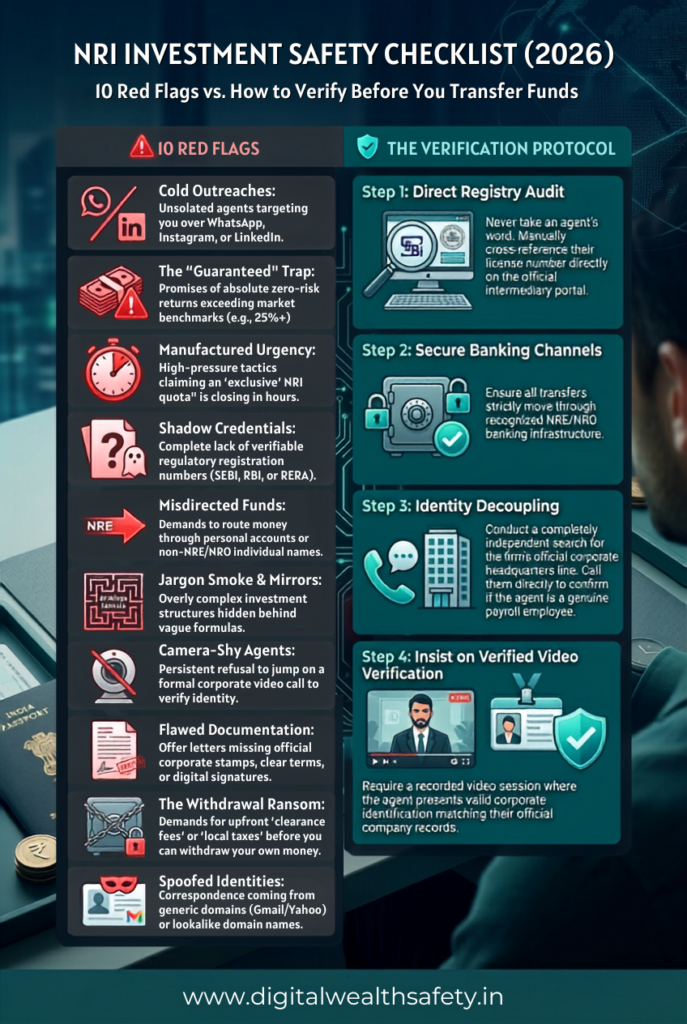
04 How to Verify If an Investment Agent Is Genuine — Five Steps
This verification process takes under ten minutes and applies to every agent, adviser, or distributor you encounter — whether they were referred by family, found on LinkedIn, or approached you directly. Familiarity and referrals do not substitute for regulatory verification.
Step 1
Go to sebi.gov.in → Intermediaries → Registered Investment Advisers. Enter the agent’s name or RIA number. If the name doesn’t match exactly, or the registration isn’t active, stop all engagement immediately. For mutual fund distributors, verify the AMFI ARN at amfiindia.com → Know Your Distributor.
Step 2
Request: SEBI RIA certificate with registration number, NISM certification (Series X-A for Investment Adviser), GST registration, PAN of the entity (not individual), and registered office address matching the SEBI filing. Verify each document against the official portal — don’t accept scanned copies without cross-verification.
Step 3
Ask the agent to show on camera: their photo ID, their office with visible company signage, their physical SEBI certificate, and their AMFI ARN card if applicable. A legitimate, registered agent has no reason to decline any of these. Refusal or evasion is conclusive.
Step 4
Legitimate agents and asset managers use corporate email domains — @icicipruamc.com, @hdfcfund.com, @kotaksecurities.com, @motilaloswal.com. An agent communicating from Gmail, Yahoo, Hotmail, Outlook, or any free email provider is not operating as a registered financial professional.
Step 5
Before any transfer, verify that the account name and number exactly match the official AMC account, broker settlement account, or RBI-approved channel listed on the institution’s official website. Call the AMC or broker’s official helpline to confirm the account details independently. Money must never go to an individual, a new account, or a payment gateway link.
Step 1 is non-negotiable and takes under two minutes. Open sebi.gov.in or amfiindia.com while the agent is still on a call with you. The most common response from fraudsters when asked for their SEBI number is delay: “I’ll send it later,” “The certificate is at the office,” “We operate under a parent entity.” Each of these is a signal to stop. A registered professional can produce their registration number in under 30 seconds.
Pro Tip
05 Four Active Scam Patterns Targeting NRI Investors in 2026
These four patterns account for the majority of investment fraud cases targeting NRIs in 2026. The scripts are refined and the documents are increasingly convincing, but the fundamental red flags are consistent across all four.
| Scam Pattern | How It Plays Out | The Give-Away |
|---|---|---|
| Fake Mutual Fund ‘NRI Window’ | Claims of special NAV rates, bonus unit allotments, or exclusive NRI-quota schemes not available through normal channels. Documents look like AMC letterheads | Claims of special NAV rates, bonus unit allotments, or exclusive NRI-quota schemes not available through normal channels. Documents look like AMC letterheads |
| PMS / AIF Guaranteed Return Scam | Promises of 18–24% annual returns with ‘capital protection’ on a Portfolio Management Service or Alternative Investment Fund | SEBI-registered PMS and AIF are legally prohibited from guaranteeing returns or capital. Any such promise is conclusive evidence of fraud |
| Real Estate Investment Trap | Pre-launch deals, guaranteed rental income of 8–12%, or ‘NRI-only discounts’ on properties that often don’t exist or aren’t legally clear | Guaranteed rental income on real estate is not regulated or enforceable. Pre-launch investments without RERA registration are illegal |
| Insurance-Cum-Investment Mis-selling | ULIPs or traditional endowment plans presented as high-return wealth products. Returns are overstated, charges are hidden, lock-in period obscured | Ask for the benefit illustration with all charges deducted, as mandated by IRDAI. The actual post-charge return on most such products is 4–5% |
The real estate investment trap deserves particular attention for NRIs with family in India. The emotional resonance of ‘investing in property back home’ is used deliberately — fraudsters know NRIs are more likely to act on this pitch without the due diligence they’d apply to a financial product. Any real estate investment must be verified against the state RERA portal before any money changes hands. Pre-launch projects without RERA registration are illegal. Guaranteed rental income is not a contractually enforceable promise in India.
06 The Only Safe, Regulated Channels for NRIs to Invest in India
The simplest protection against fake investment agents is removing the need for one. Every investment product available to NRIs in India is accessible directly through regulated, verifiable channels. The table below covers all of them.
| Channel | How to Access It as an NRI | Verification to Check First |
|---|---|---|
| Direct AMC investment | Invest directly through the AMC’s official website or app using your NRE/NRO account. HDFC AMC, ICICI Pru AMC, SBI Mutual Fund, Nippon India all have dedicated NRI portals | Verify the website URL matches the AMC’s official AMFI registration. No third party is involved |
| SEBI-registered RIA (fee-only adviser) | Registered under SEBI (Investment Advisers) Regulations, 2013. Charges a flat fee, not commissions. Find them on sebi.gov.in → Intermediaries → RIA | Verify RIA number on sebi.gov.in. Confirm active registration. Ask for the RIA-client agreement before any advice |
| AMFI-registered distributor (ARN holder) | A mutual fund distributor with an AMFI Registration Number. Earns disclosed commission from the AMC. Verify on amfiindia.com → Know Your Distributor | Verify ARN is active and the name matches exactly. Never transfer money to the distributor — only to the AMC account |
| Reputed full-service brokers | For equities, NPS, and PMS: Zerodha, ICICI Direct, HDFC Securities, Kotak Securities, Motilal Oswal, Axis Securities — all SEBI-registered with NRI onboarding | Check SEBI broker registration on sebi.gov.in → Intermediaries → Stock Brokers. Verify it matches their official website |
| RBI-approved remittance channels | Wire transfers via your NRE/NRO account to AMC or broker accounts only. FCNR deposits through your bank directly | Never use informal channels, hawala, or payment app transfers for investment. RBI-approved channels are the only legally compliant route |
The most important practical step for any NRI investing in India is to open a direct account with one or two reputed AMCs and one SEBI-registered broker. Once you have these relationships established through official channels, you have a verified baseline. Any agent who approaches you claiming to offer access to the same products through ‘better terms’ is operating outside these channels for a reason.
Pro Tip
07 Additional Security Measures Every NRI Investor Should Enable
Beyond verifying agents, these account-level protections limit the damage if something does go wrong, and create an audit trail that supports any recovery process.
- Enable international OTP and app-based 2FA on all net banking, demat, and brokerage accounts. SMS OTP to a roaming Indian number is unreliable — app-based OTP is device-bound and consistent
- Enable real-time email and push notification alerts for every transaction across every account. A fraudulent transfer noticed within minutes has a far higher recovery rate than one noticed days later
- Set per-transaction transfer limits in your bank app well below your total NRE/NRO balance. Raise only when initiating a known, verified transaction
- Enable 2FA on all demat and brokerage accounts — CDSL and NSDL-linked accounts have their own 2FA settings separate from your broker’s login
- Apply a zero-trust rule: if anything about a pitch, a process, or a payment instruction feels misaligned with how a regulated investment should work, stop immediately. The cost of pausing to verify is zero. The cost of not verifying can be everything
08 Emergency Protocol — If You Have Already Engaged a Suspicious Agent
If you’ve already shared documents, made a transfer, or signed anything with an agent you now suspect is fraudulent, act immediately. Every hour of delay reduces your recovery options. Follow these seven steps in order.
Step 1
Via your bank’s app or by calling the NRI helpline. This prevents any further transfers while you investigate. Most banks allow a temporary freeze that doesn’t affect incoming credits.
Step 2
From a secure device. If the agent had access to any document with your login details, rotate all credentials before proceeding.
Step 3
If you had granted a POA to the agent or any related party, revoke it immediately in writing. Send a revocation notice by registered post to the agent and notify your bank and broker in writing.
Step 4
SBI NRI: +91-80-26599990 | HDFC NRI: +91-22-61606161 | ICICI NRI: +91-22-33667777 | Axis NRI: +91-22-67987700. Report the suspicious agent and any unauthorised transactions, and request a review of recent account activity.
Step 5
scores.gov.in is SEBI’s official investor complaint redressal platform. Provide all documentation: WhatsApp messages, documents received, account transfer records. SEBI investigates complaints against registered and unregistered intermediaries.
Step 6
cybercrime.gov.in is the National Cyber Crime Reporting Portal. Financial fraud by fake investment agents is a cybercrime under Indian law. A registered complaint strengthens any civil recovery action.
Step 7
Anyone who may also have been approached by the same agent or network. Fraud networks targeting NRIs frequently use referral-based approaches — one contact leads to others in the same family or community.
If you’ve already transferred money, do not transfer any further amounts regardless of what the agent says — not to ‘complete the process,’ not to ‘unlock your returns,’ not to pay ‘regulatory fees.’ The request for a second transfer to resolve a problem with the first transfer is one of the most consistent patterns in investment fraud. It is designed to extract a second payment while the first is still unrecovered.
Pro Tip
Quick Reference: Key Portals and Helplines
| Item | Where to Go |
|---|---|
| Cybercrime Helpline (call) | 1930 — national cybercrime reporting hotline, available 24×7 |
| Report UPI fraud online | cybercrime.gov.in — National Cyber Crime Reporting Portal |
| NPCI UPI/IMPS dispute | npci.org.in — raise a dispute under Payments / UPI |
| Block UPI via your bank | Call your bank’s 24-hour fraud helpline — find the number in your banking app |
| UPI app — Google Pay | Download only from play.google.com — never from a link |
| UPI app — PhonePe | Download only from phonepe.com or official app stores |
| UPI app — BHIM | Download only from bhimupi.org.in or official app stores |
| Change UPI PIN | Open your UPI app → Settings → Change UPI PIN |
UPI is safe — fraud happens because scammers exploit human trust, not technical weakness. The Golden Rule covers it all: receiving money never requires your PIN. The six fraud patterns in this guide cover almost all UPI crime in India — know them and you recognise attacks instantly. The twelve rules eliminate most of your vulnerability, and they’re worth sharing with every member of your family. If fraud happens anyway, call your bank within 30 minutes, report on cybercrime.gov.in, and change your PIN immediately. Awareness doesn’t make you paranoid — it makes you a much harder target.