
Table of Contents
₹78,000 Cr
Unclaimed in banks
₹14,000 Cr
Unclaimed in insurance
₹9,000 Cr
Unclaimed dividends & shares
₹3,000 Cr
Unclaimed in mutual funds
Source: Department of Financial Services, Government of India, May 2026
Think about your father’s old Fixed Deposit from fifteen years ago — the one where the receipt got filed in a drawer and never followed up. Or the life insurance policy your grandfather took out, and nobody in the family remembered to file a claim after he passed. Or shares from a company that paid dividends for years, but because the bank account linked to the folio was closed, the money stopped arriving — and then the shares themselves moved to a government fund. These situations are more common than most families realise.
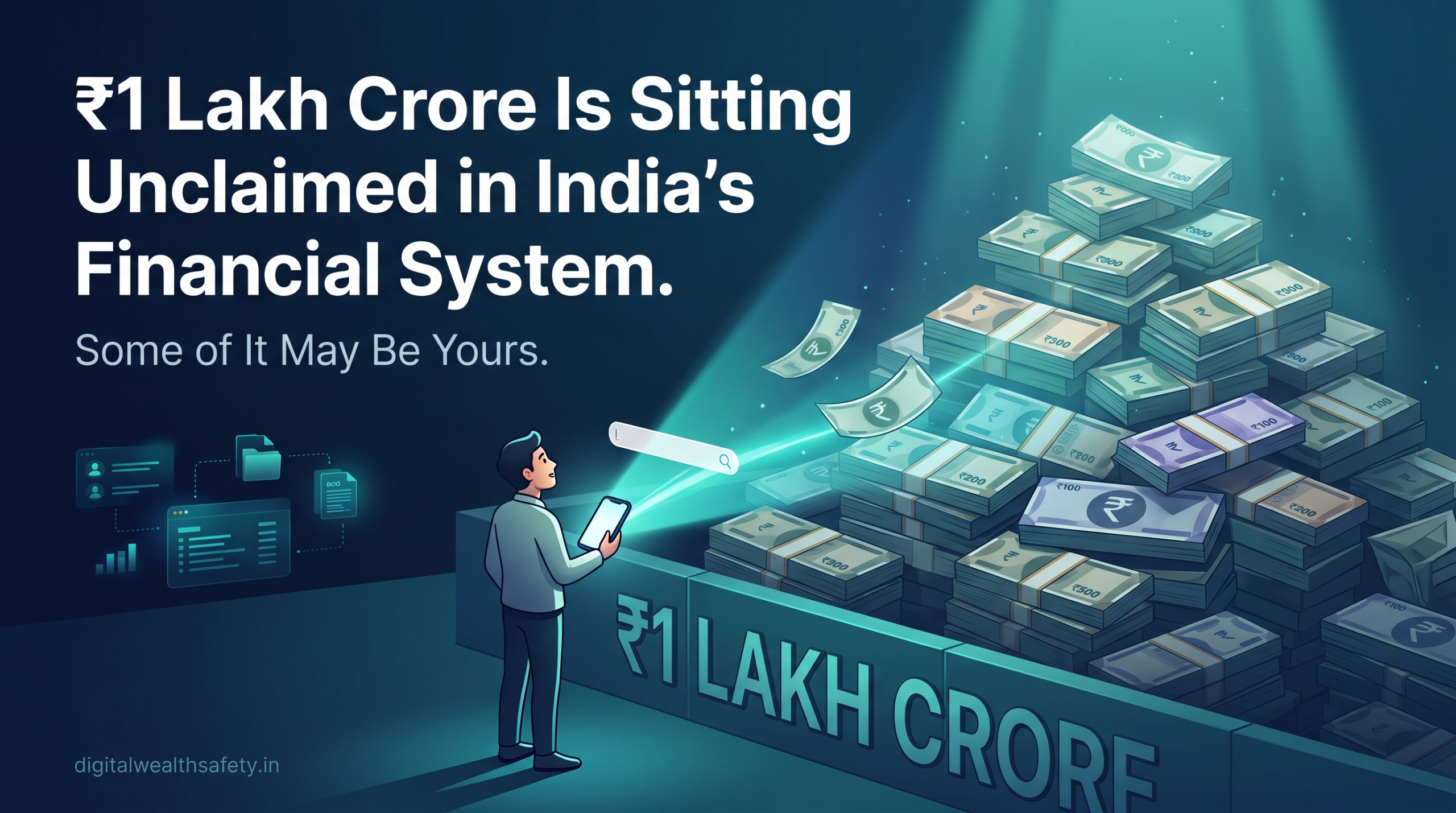
Across India’s financial system, roughly ₹1 lakh crore in deposits, policies, mutual fund units, dividends, and shares sits unclaimed — belonging to people who either do not know it exists or have not known where to look. On 29 May 2026, the Government of India addressed this directly by launching a unified Common Landing Portal at unclaimedassetsportal.in — a single starting point that connects you to every relevant regulator-managed platform. This guide explains what the portal does, where each type of asset sits, and how to search for and claim what may be yours or your family’s.
WHAT COUNTS AS 'UNCLAIMED' — AND WHEN DOES IT HAPPEN?
| Asset Type | When It Becomes 'Unclaimed' | Where It Goes |
|---|---|---|
| Bank savings or current account | No customer-initiated transaction for 10 years | Transferred to RBI's Depositor Education & Awareness (DEA) Fund |
| Fixed Deposit or Recurring Deposit | Not claimed within 10 years of maturity date | Transferred to RBI's DEA Fund |
| Life insurance policy | Maturity proceeds or death claim not collected after prescribed period | Transferred to IRDAI's Senior Citizens Welfare Fund |
| Mutual fund units | No investor-initiated transaction for 10 years (units still held) | Identified on SEBI's MITRA platform — units remain with the AMC |
| Company dividends | Unpaid or unclaimed for 7 consecutive years | Transferred to Government's IEPF (Investor Education & Protection Fund) |
| Shares linked to unclaimed dividends | Dividends unclaimed for 7 consecutive years | Shares transferred to IEPF by the company |
| EPF / PF balance | Account inoperative — no contribution for 36+ months | Managed by EPFO; accessible via e-PRAAPTI portal |
Important
Money transferred to DEA Fund, IEPF or insurance funds does NOT mean it is lost. You — or your legal heirs — can claim it back at any time. The government holds it on your behalf. There is no final deadline after which your right expires.
YOUR FIVE PORTALS — AND WHAT EACH ONE DOES
The new Common Landing Portal at unclaimedassetsportal.in acts as a single front door — it does not hold your data itself, but directs you to the right regulator’s platform based on what you are looking for. Here are the five portals, what they cover, and how to use each one.
1
Bank Deposits — RBI UDGAM Porta
What it covers: Savings accounts, current accounts, FDs, RDs — across 30 major banks covering ~90% of all unclaimed deposits
Portal: udgam.rbi.org.in (free, official RBI portal)
① Register with your mobile number. Then search by the account holder’s name + bank name + one identifier: PAN, Date of Birth, Voter ID, Driving Licence, or Passport number.
② If a match is found, you receive a Unique Deposit Reference Number (UDRN). Note this down.
③ Take the UDRN and your KYC documents to the bank branch directly. The bank verifies and credits the amount with applicable interest to your active account.
Smaller banks and cooperative banks are not yet on the portal. If you suspect a deposit with a smaller bank, visit that bank’s branch directly and ask for their unclaimed deposit list.
UDGAM covers 30 banks as of 2024
2
Mutual Fund Units — SEBI MITRA
What it covers: Inactive mutual fund folios where no transaction has occurred for 10 years — across all AMCs
Portal: MFcentral.com → click MITRA (or via amfiindia.com → Online Centre)
① Enter your PAN. Authenticate using OTP sent to your registered mobile or email. You can also add optional details — email, date of birth, address — to narrow the search.
② The platform searches across all AMCs simultaneously and shows any inactive folios under your PAN.
③ If folios are found, follow the on-screen guidance to update KYC and initiate the reclaim or transmission process through the AMC.
For legal heirs
MITRA also allows nominees and legal heirs to search for folios of a deceased investor. Use the deceased person’s PAN. You will need identity proof, relationship proof, and the death certificate to initiate a transmission claim.
3
Unclaimed Dividends & Shares — IEPF
What it covers: Dividends unclaimed for 7+ years and the linked shares, transferred to the Investor Education & Protection Fund under Ministry of Corporate Affairs
Portal: iepf.gov.in (search, then claim via MCA portal)
① Go to iepf.gov.in and search by your name, PAN, company name, or folio number to check if your dividends or shares have been transferred to IEPF.
② If transferred, file Form IEPF-5 online at the MCA portal (mca.gov.in → Company E-Filing → IEPF Services). There is no filing fee.
③ Print the completed form, attach required documents (PAN, Aadhaar, cancelled cheque, demat CMR, indemnity bond), and send the physical set to the company’s IEPF Nodal Officer at its registered office.
IEPF claim timeline
After the company verifies your documents, it forwards them to the IEPF Authority for final approval. Typical processing: 4 to 6 months for straightforward cases. Legal heir transmission cases may take longer. Claims that are rejected can be re-filed after resolving the stated reason.
4
Unclaimed Insurance Proceeds — IRDAI Bima Bharosa
What it covers: Life insurance maturity proceeds, death benefits, and health insurance amounts unclaimed for years
Portal: bimabharosa.irdai.gov.in
① Search using the policyholder’s name, policy number, or date of birth. The portal covers major life and general insurers.
② If a match is found, contact the insurer directly with the policy details and identity proof to initiate the claim.
③ For deceased policyholders, legal heirs need: death certificate, identity proof, relationship proof (succession certificate for larger amounts), and the original policy document where available.
5
EPF / Provident Fund — EPFO e-PRAAPTI
What it covers: Inoperative PF accounts where contributions stopped 36+ months ago
Portal: unifiedportal-mem.epfindia.gov.in (EPFO Member Portal)
① Log in with your UAN (Universal Account Number) and password. Go to ‘Online Services’ → ‘Claim’ to check account status and initiate withdrawal or transfer.
② If UAN is unknown, search on the EPFO portal using your PAN or Aadhaar. Your employer can also provide UAN details.
③ For accounts of deceased members, legal heirs file Form 20 (PF) and Form 10D (pension) offline at the EPFO regional office with death certificate and succession documents.
WHO SHOULD SEARCH — AND WHEN TO SEARCH FOR A FAMILY MEMBER
| Your Situation | What to Search | Where to Start |
|---|---|---|
| You have old bank accounts you no longer use | Dormant savings/FD in your own name | udgam.rbi.org.in |
| You held mutual funds years ago — not sure if all are active | Inactive folios under your PAN | MFcentral.com → MITRA |
| You inherited shares or hold a deceased parent's demat account | Shares/dividends transferred to IEPF | iepf.gov.in then MCA portal |
| A parent/spouse passed away with insurance — claim not fully settled | Unclaimed insurance proceeds | bimabharosa.irdai.gov.in |
| You changed jobs and left a PF account with an old employer | Inoperative EPF balance | EPFO Member Portal using UAN |
| You are an NRI managing a parent's Indian finances remotely | All of the above — run searches on behalf of the account holder | unclaimedassetsportal.in → relevant portal |
| You want to check everything in one go | All asset types | unclaimedassetsportal.in — the unified starting point |
WHAT DOCUMENTS TO KEEP READY
Before you start a claim (not just a search — which is free and requires nothing), gather these:
| Document | Why You Need It |
|---|---|
| PAN card (yours and/or the original account holder's) | Primary identifier on all portals |
| Aadhaar card | Identity verification for claims; linked to bank accounts |
| Death certificate | For all claims involving a deceased account holder or policyholder |
| Legal heir certificate / succession certificate | Required for larger claims from banks, IEPF, insurance |
| Relationship proof (ration card, family ID, will) | To establish your entitlement as legal heir |
| Original policy document, passbook, or FD receipt (where available) | Speeds up verification — not always mandatory but helpful |
| Cancelled cheque (with name printed) | For bank account credit on successful claim |
| Demat account CMR (Client Master Report) | Required for IEPF share transfer — get from your broker |
| Indemnity bond (notarised) | Required for IEPF claims ≥₹10,000; plain paper for smaller amounts |
Search first — it is always free and takes under five minutes. You do not need any documents just to check whether money is sitting unclaimed in your name or a family member’s name. Start at unclaimedassetsportal.in and let the portal direct you. Only when you find something do you need to gather documents and initiate a formal claim.
Golden Rule
FRAUD WARNING — PROTECT YOURSELF WHILE SEARCHING
The Government’s unclaimed asset initiative has created a parallel problem: scammers have started targeting people with calls and messages claiming to be from the RBI, SEBI, or IRDAI, offering to ‘help you recover your dormant money’ in exchange for a processing fee, OTP, or bank account access. These are frauds. Here is how to stay safe:
Never do these things
Never share your OTP, internet banking password, ATM PIN, or debit/credit card number with anyone claiming to help you recover unclaimed money. Never pay a ‘processing fee’ or ‘release charge’ to recover your own assets — there is no such fee on any government portal. Never click links received via WhatsApp, SMS, or email that claim to take you to UDGAM, MITRA, IEPF, or any similar portal — type the URL directly in your browser.
| Official Portal | Correct URL | Never Pay a Fee To |
|---|---|---|
| Common Landing Portal (all assets) | unclaimedassetsportal.in | Anyone on phone, WhatsApp, or email |
| Blocks login attempts from unregistered devices even when credentials are correct | udgam.rbi.org.in | Anyone — search is completely free |
| SEBI MITRA (mutual funds) | MFcentral.com → MITRA | Any 'agent' promising to file on your behalf |
| IEPF (dividends & shares) | iepf.gov.in and mca.gov.in | IEPF filing itself is free — avoid paid 'claim agents' |
| IRDAI Bima Bharosa (insurance) | bimabharosa.irdai.gov.in | Anyone — contact insurer directly for claims |
| EPFO (PF) | unifiedportal-mem.epfindia.gov.in | Any third party — use only the official portal |
| RBI Cybercrime Helpline | Dial 1930 | Report any fraud attempt immediately |
YOUR ACTION LIST — DO THIS TODAY
- Go to unclaimedassetsportal.in — spend 10 minutes searching your own name and PAN across all asset types.
- Search for your parents’ names if they are senior citizens or if a parent has passed away. Old FDs, insurance policies, and shares are the most commonly forgotten assets.
- If you are an NRI managing a parent’s finances in India, this is particularly important — use the Common Landing Portal as your starting point.
- If a search returns a result, gather the relevant documents (PAN, Aadhaar, death certificate if applicable) and follow the claim process on the specific regulator’s portal.
- Do not pay anyone to help you. All searches are free. Claim filing on IEPF, EPFO, UDGAM, and MITRA has no government fee.
- If you receive a call or message about unclaimed money, hang up and report it to the cybercrime helpline at 1930.
Key Takeaway
India’s financial system holds over ₹1 lakh crore in unclaimed deposits, policies, mutual funds, dividends, and shares. For the first time, the Government of India has unified access to all of this through a single portal — unclaimedassetsportal.in — launched in May 2026. The search takes minutes and is free. The claim process requires documents and some patience, but the money remains yours — or your family’s — to recover regardless of how long it has been sitting unclaimed. Do the search. You may be surprised what you find.