
Table of Contents
The complete 2026 guide to India’s fastest-growing investment category — what it is, the two rules nobody explains, and what to check before you commit ₹10 lakh.
₹23,177 cr
CATEGORY AUM, JULY 2026
94,447
INVESTOR FOLIOS
₹10 lakh
MINIMUM, PER PAN
25%
MAX UNHEDGED SHORT
There is a category of investment product in India that did not exist two years ago. It is not a mutual fund. It is not PMS. It is not an AIF. In October 2025 it held ₹2,010 crore. Nine month-ends later it holds ₹23,177 crore. Most people who have money in it cannot fully explain what it is — and the two rules that matter most are the two that almost every online explainer leaves out.
The 30-second answer
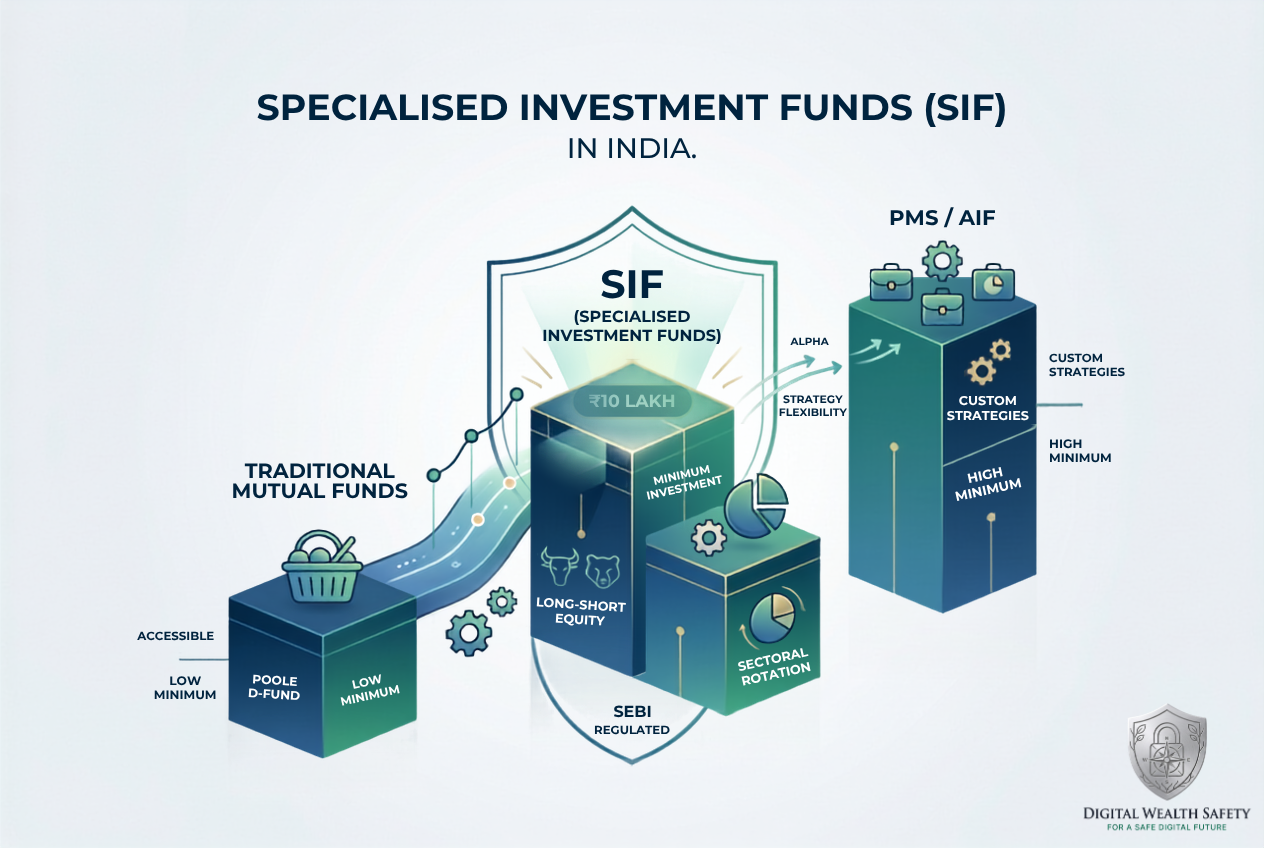
A Specialised Investment Fund (SIF) is a SEBI-regulated investment vehicle that sits between mutual funds and Portfolio Management Services. It is run by an existing mutual fund house, under mutual fund regulations and mutual fund expense caps — but unlike a mutual fund, a SIF can take unhedged short positions using derivatives, up to 25% of its net assets.
- Minimum investment:₹10 lakh, aggregated at PAN level across all SIF strategies of one AMC
Introduced:SEBI (Mutual Funds) Regulations amendment, December 2024; detailed circular 27 February 2025; effective 1 April 2025; first schemes took money from October 2025- Category size:₹23,177 crore across roughly 30 to 33 live strategies from about 16 to 17 AMCs
- Regulated under:the SEBI (Mutual Funds) Regulations — the same framework as your equity fund
- What you own: units, exactly as in a mutual fund (not individual shares in your demat, as in PMS)
01 What a SIF actually is
The gap SEBI was trying to fill
Indian investing had a hole in the middle of it.
At one end, mutual funds. You can start with ₹100. Tightly regulated, cheap, transparent. But a mutual fund manager can only buy. If he is convinced a stock is overvalued and about to fall, the most aggressive thing he can legally do is not own it. He cannot profit from being right about a decline.
At the other end, Portfolio Management Services. Far more strategic freedom, and a minimum ticket of ₹50 lakh.
Between those two sat a large and growing group of Indians — people with ₹10 lakh, ₹20 lakh, ₹30 lakh to deploy, who had been investing for a decade, who had outgrown a plain flexicap fund, and who were nowhere near the PMS door.
SEBI’s answer was a new category. The enabling amendment to the SEBI (Mutual Funds) Regulations, 1996 took effect in December 2024. The operating framework arrived through SEBI circular SEBI/HO/IMD/IMD-PoD-1/P/CIR/2025/26 dated 27 February 2025, effective 1 April 2025, with clarifications in April 2025 and a further circular in July 2025. The first schemes began accepting money in October 2025.
The one thing that makes a SIF different
Shorting.
A SIF manager can bet against a stock or a sector and profit if it falls. This is done through exchange-traded derivatives, and SEBI has fenced it carefully:
- Unhedged short exposure: maximum 25% of net assets.A SIF may hold up to 25% of net assets in exchange-traded derivatives for non-hedging purposes. A matching long position does not cancel out an unhedged short for the purpose of this cap.
- Cumulative gross exposure across cash and derivatives cannot exceed 100% of net assets.This is the outer boundary, and it is the limit that stops a SIF from becoming a leveraged hedge fund.
- Options exposure is capped at 20% — and this is the detail almost every explainer omits — that 20% is measured on the option premium paid, not on the underlying notional exposure.
That last point matters. Because the cap applies to premium rather than notional value, the fund’s actual market exposure through options can be meaningfully larger than 20% of the portfolio. It is not unlimited — the 100% cumulative gross exposure ceiling still binds, as do single-issuer and sector limits. But if you are assessing risk by reading “20% cap” and picturing 20% of the portfolio, you are picturing it wrong.
Seven strategies. Two have never been used.
SEBI did not leave this open-ended. It defined exactly seven investment strategies across three categories, and an AMC may launch only one strategy per category type — which is why you do not see forty confusing schemes from a single fund house.
Equity-oriented strategies
| Strategy | Mandate |
|---|---|
| Equity Long-Short Fund | Minimum 80% in equity and equity-related instruments |
| Equity Ex-Top 100 Long-Short Fund | Minimum 65% in companies outside the top 100 by market capitalisation |
| Sector Rotation Long-Short Fund | Minimum 80% equity, concentrated in a maximum of four sectors at a time |
Hybrid strategies
| Strategy | Mandate |
|---|---|
| Hybrid Long-Short Fund | Minimum 25% equity and minimum 25% debt |
| Active Asset Allocator Long-Short Fund | Flexible across equity, debt, REITs, InvITs and commodity derivatives |
Debt-oriented strategie
| Strategy | Mandate |
|---|---|
| Debt Long-Short Fund | Debt across maturities, with unhedged short exposure via exchange-traded debt derivatives |
| Sectoral Debt Long-Short Fund | Sector-specific debt portfolios |
The two categories the industry ignored
In the entire history of the category, not one debt SIF has launched. Debt AUM has been zero in every AMFI table since October 2025. SEBI built a complete debt long-short framework — and the industry has not used it, presumably because there is no retail appetite for shorting bonds and no straightforward way to market it.
Two of SEBI’s seven strategies therefore exist only on paper. When you read that SIFs offer “seven strategies,” the number you can actually buy is five.
SIF vs Mutual Fund vs PMS
| Mutual Fund | SIF | PMS | |
|---|---|---|---|
| Minimum investment | ₹100 | ₹10 lakh | ₹50 lakh |
| Can take short positions | No | Yes, up to 25% unhedged | Yes |
| Regulated under | MF Regulations | MF Regulations | PMS Regulations |
| Expense ratio capped | Yes | Yes — same caps as MF | No cap |
| What you own | Units | Units | Securities in your demat |
| NAV published | Daily | Daily | Not applicable |
| Portfolio disclosed | Monthly | Every alternate month | Varies by manager |
| Risk display | Riskometer | Risk-band, 1 to 5 | None mandated |
| Redemption | Usually daily | Daily for equity; interval permitted for debt and hybrid | Varies |
Three rows deserve more than a glance.
The expense cap is a genuine, structural advantage. Because a SIF sits under mutual fund regulations, its expense ratio is capped exactly as a mutual fund’s is. PMS has no such cap. For an investor comparing a SIF against a PMS strategy, this is a real point in the SIF’s favour and it deserves to be said plainly.
The disclosure row cuts the other way. A mutual fund publishes its full portfolio every month. A SIF discloses its portfolio, including derivative positions and ISINs, only as on the last day of every alternate month, and then has ten days to publish it. So for a product built around derivatives and short positions — the very things you would most want visibility into — you see materially less than you would in a plain equity fund. The NAV comes daily. The positions do not.
The redemption row is more specific than most explainers admit. Equity-oriented SIF strategies must offer daily redemption. Intermittent, interval-style redemption is permitted only for debt and hybrid strategies — and several large hybrid funds use it. JioBlackRock’s Prism Hybrid Long-Short Fund, for instance, is an interval strategy that opens for redemption twice a week. Close-ended and interval strategies must be listed on a recognised stock exchange to give investors an exit route.
The AMC has to earn the right to launch one
Not every fund house can offer a SIF. There are two qualifying routes:
Route 1 — track record
The mutual fund has been in operation for at least 3 years, with average AUM of at least ₹10,000 crore over the preceding 3 years.
Route 2 — people
A Chief Investment Officer with at least 10 years of fund management experience managing average AUM of at least ₹5,000 crore, plus an additional fund manager with at least 3 years of experience and ₹500 crore of average AUM.
The separate brand name is deliberate
SEBI made it mandatory for an AMC to run its SIF under a brand name and logo distinct from its mutual fund business. That is why you see:
| Fund house | SIF brand |
|---|---|
| ICICI Prudential Mutual Fund | iSIF |
| SBI Mutual Fund | Magnum |
| Tata Mutual Fund | Titanium |
| Aditya Birla Sun Life Mutual Fund | Apex |
| Edelweiss Mutual Fund | Altiva |
| ITI Mutual Fund | Diviniti |
| Quant Mutual Fund | qSIF |
| Bandhan Mutual Fund | Arudha |
| JioBlackRock Asset Management | Prism |
This rule exists for a reason worth sitting with. The regulator was concerned enough that investors might confuse a SIF with a familiar mutual fund that it required a separate brand identity for the product. Several of these brands still visibly trace back to the parent — iSIF to ICICI Prudential, qSIF to Quant — so this is a distinct-identity requirement rather than a total prohibition on the parent name. But when a regulator takes even that step, it is telling you something about how easily the product can be mistaken for something safer.
02 The ₹10 lakh rule — and the part nobody explains
The minimum is ₹10 lakh. It has always been ₹10 lakh. It has never been reduced.
It applies at PAN level, aggregated across all SIF strategies of the same AMC — not per scheme. Your mutual fund holdings at that same AMC do not count towards it. Accredited investors, as defined by SEBI, are exempt, as are mandatory investments made by AMCs on behalf of designated employees.
Four reasons you will see a lower number quoted
- SIP marketing. Some funds advertise “₹10 lakh lump sum or ₹10,000 via SIP.” SIPs, STPs and SWPs are indeed permitted — but your aggregate must still reach, and then maintain, ₹10 lakh. JioBlackRock’s Prism fund states this explicitly: the ₹10,000 minimum SIP is available only alongside a ₹10 lakh subscription.
- The aggregate framing. Explainers say “invest ₹6 lakh in one strategy and ₹4 lakh in another.” That is one ₹10 lakh floor split across strategies, not a ₹4 lakh minimum.
- The accredited investor exemption, quoted without its qualifier.
- Confusion with the PMS proposal. On 23 July 2026 SEBI issued a consultation paper proposing a new MF-only PMS category at a ₹25 lakh minimum. That is a different product, comments closed on 13 August 2026, and as of this writing it remains a proposal. Standard PMS is still ₹50 lakh.
Two kinds of breach — and both restrict you
This is the most under-reported part of the entire SIF framework, and it should change how you think about the product. SEBI requires AMCs, RTAs and depositories to monitor your balance daily. What happens when you fall below ₹10 lakh depends entirely on why you fell below it.
| Passive breach | Active breach | |
|---|---|---|
| What causes it | Markets fell. Your holding lost value through no action of yours. | You redeemed, switched, sold or transferred units. |
| Are your units frozen? | No. | Yes — every unit you hold across every strategy of that SIF is frozen for debit. |
| Can you take part of the money out? | No. You are permitted only to redeem the entire remaining investment from the SIF. | No. The freeze blocks all debits until you restore the balance. |
| Is there a clock? | No notice period applies. | 30 calendar days to rebalance above ₹10 lakh. |
| What if you do nothing? | Nothing happens. You stay invested. | The AMC automatically redeems your entire frozen holding at the NAV of the next business day after the 30th day. |
Correcting a widespread misreading
A great deal of published coverage summarises the passive breach as “nothing happens — you are fine.” That is only half true. Nothing punitive happens: there is no freeze, no notice, no forced exit. But the February 2025 circular is explicit that where the value has fallen below the threshold through a passive breach, the investor shall only be permitted to redeem the entire remaining investment amount from the SIF.
In plain terms: once markets have pushed you below ₹10 lakh, your only exit is a full exit. The partial withdrawal is closed off in both scenarios — by a rule in one, by a freeze in the other.
What this looks like in real life
You invest ₹12 lakh. A year later you need ₹4 lakh for something — a medical bill, a school fee, a property deposit.
Taking ₹4 lakh out drops you to ₹8 lakh. That is an active breach. Your entire position across every strategy of that SIF is now frozen, and you have 30 days to either put the money back or be liquidated out of the whole thing — at a NAV on the AMC’s calendar, not yours.
Now run the other version. Markets fall 20% and your ₹12 lakh becomes ₹9.6 lakh. You still need ₹4 lakh. You cannot take ₹4 lakh; you can only redeem the whole ₹9.6 lakh — crystallising the entire loss to fund a partial need.
Partial exit, in this product, is effectively not available in either direction. Against an average of roughly ₹24.5 lakh per folio, that is a serious constraint, and no marketing brochure leads with it.
03 Tax: the one line in the document that decides your bill
Almost every SIF page online says the same thing: SIFs are taxed like equity funds — 20% short-term, 12.5% long-term after 12 months, with long-term gains up to ₹1.25 lakh per financial year exempt.
That is correct — but only if the strategy holds at least 65% in listed equity.
If a SIF strategy does not meet that 65% test — and several hybrid strategies deliberately do not, because they are built around arbitrage, covered calls, merger arbitrage and fixed income — the treatment changes materially. The long-term holding period stretches to 24 months, and gains realised before that are taxed at your slab rate.
| Strategy holds ≥65% listed equity | Strategy holds <65% listed equity | |
|---|---|---|
| Long-term threshold | 12 months | 24 months |
| Short-term gains | 20% | Your slab rate |
| Long-term gains | 12.5%, with ₹1.25 lakh per year exempt | 12.5% |
| Where to check | Asset allocation table in the ISID / SID | Asset allocation table in the ISID / SID |
Run the arithmetic once and it stops being abstract
An investor in the 30% bracket exits at 14 months believing short-term gains attract 20%. Because the strategy holds 55% listed equity, 14 months is still short-term and the actual liability is slab rate.
On ₹10 lakh of gains, the difference between 20% and 30% is ₹1 lakh — decided entirely by an asset allocation line in a document that was never opened.
Two funds. Same category name. Same ₹10 lakh minimum. Completely different tax outcomes.
Before you invest in any SIF, find the asset allocation band in the Investment Strategy Information Document and work out whether it clears 65% listed equity. For most investors, it will affect the net return more than the fund’s performance will. And note that the test applies to the strategy’s actual holdings, so a fund sitting near the boundary can move between treatments — which is exactly why the band, not a single month’s snapshot, is the thing to read.
04 What the numbers actually show
The growth is real
| Month-end | Category AUM | Net inflow | Folios |
|---|---|---|---|
| October 2025 | ₹2,010 cr | ₹2,005 cr | 10,212 |
| December 2025 | ~₹4,871 cr | — | — |
| February 2026 | ₹9,711 cr | — | — |
| March 2026 | ₹10,620 cr | — | — |
| May 2026 | ₹13,814 cr | ₹1,396 cr | — |
| June 2026 | ₹17,858 cr | ₹3,782 cr | — |
| July 2026 | ₹23,177 cr | — | 94,447 |
That is one of the fastest build-ups of any new regulated investment category India has seen. It is worth being careful with the word “investors,” though: 94,447 is a folio count, not a headcount. Because the ₹10 lakh floor is aggregated at PAN level across strategies, an investor holding three strategies at one AMC generates three folios. The ₹24.5 lakh average is therefore per folio, and the average per actual investor is at least that and probably higher.
But look at what people are actually buying
As of July 2026, hybrid strategies account for 71% of category AUM — ₹16,524 crore — with Hybrid Long-Short alone at ₹15,374 crore, or 66% of the entire category. Equity-oriented strategies make up the remaining 29%. Debt is nil.
That is worth pausing on. The headline feature of a SIF is the ability to run aggressive long-short equity strategies. Yet roughly two-thirds of the money has gone into conservative hybrid products built around arbitrage, covered calls and fixed income.
Investors are not buying the exotic strategy. They are buying downside protection. Which raises the obvious question: has that protection actually been delivered?
“Every fund beat its benchmark” — and what that sentence is hiding
In mid-2026 the industry began circulating an appealing statistic. As of 23 June 2026, every SIF scheme with roughly six months of history had outperformed its benchmark, by margins ranging from about 3 to nearly 10 percentage points — seven schemes in all, at that point.
That statement appears to be accurate. It is also doing an enormous amount of work. Five things sit underneath it.
-
Beating a benchmark and making money are not the same thing
By late March 2026, every live equity-oriented SIF strategy on AMFI’s NAV page was below its issue price. Through May 2026, equity long-short SIFs ranged from roughly +3% to nearly −7% since inception. A fund that fell 7% while its benchmark fell 12% has beaten its benchmark and lost you money.
-
Category averages hide enormous dispersion
During the March 2026 correction, when the Nifty fell 11.30%, the spread between the best and worst hybrid long-short SIF was more than 8 percentage points. Same category. Same marketing promise. Eight points apart.
-
Every fund in the category is under one year old
Most launched between October 2025 and March 2026, which means “since inception” covers a completely different market regime for each fund. A fund showing −3% may have launched a week before the correction and performed admirably. A fund showing +15% may simply have launched at a good moment.
-
Benchmarks differ by strategy
Nifty 500 TRI for Equity Long-Short. Nifty 50 Hybrid Composite Debt 50:50 for Hybrid Long-Short. Nifty Midsmallcap 400 for Ex-Top 100. Comparing headline returns across these categories is meaningless, and a fund measured against an undemanding benchmark can outperform without doing anything impressive.
-
The protection cuts both ways
The covered-call and hedging structures that cushioned the March fall will equally cap your gains in a strong bull run. That is not a flaw — it is the mechanism working exactly as designed. But it is rarely mentioned by the people selling it.
What would actually constitute evidence
A fair assessment of any SIF needs at minimum two to three years spanning a full market cycle — a sustained bull run, a proper correction, and a recovery. The category has had roughly ten months and one correction.
Everything else so far is distribution, not track record.
05 Where retail investors are most likely to get hurt
First, a statement of what we are not saying
As of this writing we are aware of no SEBI enforcement action involving a SIF, no documented SIF mis-selling case, and no reported fake-SIF fraud. Nothing in this section is a report of wrongdoing, and we will not manufacture one.
What follows is pattern recognition. These are the structural conditions that have historically preceded mis-selling in Indian financial products — and a SIF ticks several of them.
- A ₹10 lakh ticket in an unfamiliar product
- “Downside protection” is a marketing phrase, not a guarantee
- The liquidity terms are genuinely restrictive
4. The distribution pipe is being widened right now
This is the most concrete near-term change in the category, and it is not about the funds at all. It is about who is allowed to sell them.
Until mid-2026, any distributor wanting to sell a SIF had to clear NISM Series XIII: Common Derivatives Certification — an exam built for derivatives professionals, not mutual fund distributors. It was a real bottleneck, and it kept the SIF distribution pool small.
That bottleneck is being removed. NISM announced a purpose-built exam, NISM Series V-D: Mutual Fund – Specialized Investment Fund Distributors Certification, on 14 July 2026, with registrations opening on 22 July 2026. SEBI has discontinued the Series XIII requirement for SIF distribution after 21 September 2026. Distributors who already hold a SIF licence through Series XIII need not re-sit anything; their certification stands until it expires. AMFI has since clarified that clearing V-D also removes the need to separately hold NISM Series V-A, so a single exam now delivers both a mutual fund licence and a SIF licence.
Separately, SEBI’s 23 July 2026 consultation paper proposes a mutual fund-only PMS category at a ₹25 lakh minimum, which would let portfolio managers build client portfolios exclusively from direct plans of mutual funds, ETFs and SIFs. Comments closed on 13 August 2026. If notified, that creates a second substantial pipe pointing at this category.
None of this is improper. A simpler, better-targeted exam is a sensible reform, and a lower-cost PMS tier is a reasonable idea.
But the combined effect is that a ₹10 lakh product with a ten-month track record is about to become dramatically easier to sell, to a wider audience, by a much larger number of people — many of them newly certified. More distribution is not the same as more suitability. Expect the volume of SIF pitches you receive to rise sharply from late 2026, and calibrate your scepticism accordingly.
- The scam risk is anticipatory, not historical
- The strategy appears in AMFI’s SIF sectionat amfiindia.com, with a published NAV in AMFI’s official SIF NAV feed matching the NAV you have been quoted.
- The AMC is a SEBI-registered mutual fund, and the SIF brand traces back to it on the AMC’s own website — not on a third-party page that merely says so.
- Payment goes to the AMC’s own collection account.Never to an individual. Never to a distributor’s personal account. Never to a UPI handle shared over chat.
- Your distributor’s ARN is valid and carries a live SIF registration.SIF registration is linked to the ARN and is administered by CAMS on AMFI’s behalf; if the ARN lapses, the SIF registration lapses with it.
- You have received the ISID, SID, SAI and KIM.A real SIF always has all four, and the ISID must contain a scenario analysis showing how the strategy behaves in different market conditions.
- Nobody is creating urgency. Anyone manufacturing a “closing window” on a ₹10 lakh transfer is telling you exactly what they are.
06 Who this product is, and is not, for
- Have ₹10 lakh or more that you can genuinely leave untouched for several years
- Already hold a diversified mutual fund portfolio, and are adding a satellite allocation — not a core one
- Understand what a short position is, and why a 25% unhedged cap matters
- Have read the ISID and can state the asset allocation band and the resulting tax treatment from memory
- Accept that you are an early adopter in a category with no full-cycle track record
- Would be putting in a large share of your investable assets
- May need part of the money back — remember that partial withdrawal is closed off in both breach scenarios
- Are attracted primarily by “beats its benchmark” or “downside protection” claims
- Cannot explain, in your own words, how the fund makes money when markets fall
There is no shame in the second list. A well-chosen index fund and a flexicap fund will serve most Indian investors better than a product that has existed for ten months.
07 What we still do not know
Honesty about the limits of the available information matters more in a young category than in an old one.
- No full-cycle performance data exists.One correction is not a track record.
- Fee-versus-alpha is unproven.Whether these strategies justify their costs over a full cycle is an open question, and nobody can currently answer it with data.
- The two debt categories are untested— no fund has launched in either.
- Risk-band assignments deserve scrutiny.Some hybrid strategies carry surprisingly low risk-band ratings for products permitted to use derivatives and unhedged shorts. The annual 31 March disclosure of risk-band changes will be the first real test of whether these bands move honestly.
- The live scheme count is genuinely uncertain.Independent trackers put it between 25 and 33 strategies across 13 to 17 AMCs during August 2026, depending on when each was refreshed and whether NFOs are counted. AMFI is the authority; treat aggregator counts as indicative.
- The MF-PMS consultation outcome is pending, and would materially change distribution if notified.
We will update this guide as AMFI publishes monthly data and as the category accumulates history.
Read the asset allocation band before you read the returns. In a SIF, one line in the Investment Strategy Information Document decides whether your long-term clock is 12 months or 24, and whether your short-term gains are taxed at 20% or at your slab rate.
In a category where every fund is under a year old and no fund has a meaningful track record, that line will affect your net outcome more reliably than any performance number you are shown.
08 Frequently asked questions
What is the full form of SIF?
Specialised Investment Fund. Some sources write it as Specialized Investment Fund; both refer to the same SEBI category.
What is the minimum investment in a SIF?
₹10 lakh, aggregated at PAN level across all SIF strategies of the same asset management company. It is not ₹10 lakh per scheme, and your ordinary mutual fund holdings at that AMC do not count towards it. Accredited investors are exempt.
Can I invest in a SIF through a SIP?
Yes. SIPs, STPs and SWPs are permitted, but your total investment must reach and then maintain the ₹10 lakh threshold. A ₹10,000 monthly SIP does not exempt you from the floor — in most funds it is offered only alongside a ₹10 lakh subscription.
What happens if my SIF investment falls below ₹10 lakh?
It depends on why. If it fell because markets declined, that is a passive breach: your units are not frozen, but you may then redeem only your entire remaining investment, not part of it. If it fell because you redeemed, switched or transferred, that is an active breach: all your units in that SIF are frozen, you get 30 calendar days to restore the balance, and failing that the AMC automatically redeems your entire holding at the NAV of the next business day.
How is a SIF taxed?
It depends on the strategy’s asset allocation. If it holds 65% or more in listed equity, short-term gains are taxed at 20% and long-term at 12.5% after 12 months, with long-term gains up to ₹1.25 lakh per year exempt. If it does not meet the 65% test, the long-term holding period extends to 24 months and short-term gains are taxed at your slab rate. Check the Investment Strategy Information Document.
Is a SIF riskier than a mutual fund?
Structurally, yes. SIFs can use derivatives and hold unhedged short positions up to 25% of net assets, which a mutual fund cannot. They also disclose their portfolio only every alternate month rather than monthly. SEBI reflects this with a risk-band scale of 1 to 5, reviewed monthly, instead of the standard riskometer.
How many SIFs are there in India?
Independent trackers put the figure at roughly 30 to 33 live strategies from about 16 to 17 AMCs as of August 2026, spanning five of SEBI’s seven permitted strategies. The count changes almost monthly. No debt SIF has launched. AMFI’s SIF section is the authoritative list.
Is a SIF the same as an AIF?
No. AIFs are governed by separate regulations, with a ₹1 crore minimum for most categories and different tax treatment. A SIF sits under mutual fund regulations with a ₹10 lakh minimum, mutual fund expense caps and mutual fund taxation.
Do I need a special distributor to buy a SIF?
Your distributor needs a valid ARN plus a SIF registration. Until 21 September 2026 that registration rests on NISM Series XIII; from then on it rests on the new NISM Series V-D exam. Existing Series XIII holders keep their licence until it expires. Ask to see it — a distributor without SIF registration cannot legitimately place your money.
Can NRIs invest in SIFs?
NRI eligibility follows each AMC’s own policy alongside the usual FEMA and KYC requirements, and treatment differs for investors based in the United States and Canada. Confirm with the specific fund house before proceeding rather than relying on a platform’s general statement.
Where can I check official SIF data?
AMFI publishes monthly SIF AUM, flow and folio data at amfiindia.com, along with the official SIF NAV feed, new fund offer listings and total expense ratio disclosures.
Key takeaway — the three things to carry away
- A SIF is not a mutual fund and SEBI was concerned enough about that confusion to require fund houses to sell it under a distinct brand identity. Regulators do not do that casually.
- Find the asset allocation line before you invest. It decides your tax treatment, and in a category this young that will affect your net outcome more than the fund’s performance does.
- Understand the exit rules before you enter, not when you need the money. Redeem part of your holding and you trigger a freeze, a 30-day clock and possible forced liquidation of the whole position. Let markets take you below the floor and you may exit only in full. Partial withdrawal is closed off either way.
09 Where to verify, and where to escalate
Every number and rule in this guide can be checked at source. Bookmark these before you need them, not after.
| What you need | Where to go | Contact |
|---|---|---|
| Official SIF scheme list, NAV feed, TER and monthly AUM data | AMFI — SIF section | amfiindia.com/sif |
| The governing rules in full — circulars, framework, thresholds | SEBI — Legal / Circulars | sebi.gov.in |
| Investor guidance and education material | SEBI Investor portal | investor.sebi.gov.in |
| General queries on the securities market | SEBI toll-free investor helpline | 1800 266 7575 or 1800 22 7575 (9 am–6 pm) |
| A complaint against an AMC, RTA or intermediary | SEBI SCORES | scores.sebi.gov.in |
| Escalating an unresolved complaint to conciliation or arbitration | SMART ODR | smartodr.in |
| Reporting a suspected fraud, fake app, cloned site or transfer scam | National Cyber Crime Reporting Portal | 1930 · cybercrime.gov.in |
| Reporting a suspected securities-law violation to SEBI | SEBI Market Intelligence portal | mi.sebi.gov.in |