

Rs. 1 crore sounds like a lot. But at 6% inflation, your Rs. 50,000 monthly need becomes Rs. 1.2 lakh in just 15 years. Here is a practical, number-backed framework to make it last a lifetime.
Table of Contents
30+ Years
Your corpus must last
11-14%
Annual medical inflation
Rs. 1.2 Lakh
Today’s Rs. 50K in 15 years
India does not offer a reliable social safety net. Medical costs are doubling every 5 to 7 years. The go-to move for most retirees — parking everything in fixed deposits — barely keeps up with inflation after taxes. It feels safe, but it is slowly bleeding your corpus dry. The old playbook no longer works.
This post lays out a practical plan: how different income strategies compare, which government-backed schemes deserve your money, how to split your corpus between growth and safety, and which tax moves to make under the new regime.
The Evolving Retirement Challenge in India
Your parents might have planned for 10 to 15 years of retirement. You could easily be looking at 30 to 40 years or more without a regular paycheck. This is longevity risk in action: the very real possibility that you will outlive your money.
India does not make this easier. The Mercer CFA Institute Global Pension Index has rated India’s pension system a ‘D’. You are essentially on your own when it comes to building and protecting your retirement nest egg.
Healthcare expenses in India double roughly every 5 to 7 years. Medical inflation runs between 11% and 14% annually — far outpacing general inflation. A surgery costing Rs. 2 lakhs today might cost Rs. 4 lakhs in just seven years.
At approximately 6% annually, the Rs. 50,000 monthly income that feels comfortable today will need to become Rs. 1.2 lakh per month in just 15 years to maintain the same lifestyle.
Core Principles for Protecting Your Corpus
Tax efficiency is not optional anymore. With the New Tax Regime becoming the default in 2026, taxes can silently erode your returns faster than you realise. Every rupee lost to unnecessary taxation is a rupee that cannot compound for your future.
Equity investments might feel risky, but they are the only reliable way to actually grow your wealth above inflation. The old FD-only strategy is a slow march toward financial erosion — a diversified approach is essential.
Strategy Comparison: Which Approach Actually Works?
Traditional strategies sound good in theory, but often fail against real-world needs. Here is how major retirement income strategies compare on inflation protection:
| Strategy | Inflation Protection | Key Limitation | Corpus Duration |
|---|---|---|---|
| Fixed Deposits | 38% | Corpus depletes by age 75 | ~15 years |
| Life Annuity | 55% | Capital permanently locked, no legacy | Lifetime (but shrinking value) |
| SWP (Mutual Funds) | 68% | Falls short of age 83 | ~23 years |
| Goal-Based (ScientificPay) | 101% | Requires disciplined planning | Full lifetime + legacy |
Essential Government-Backed Schemes
Government schemes form the bedrock of retirement stability in India. Here is where each stands in 2026:
| Scheme | Rate | Max Investment | Payout | Tax Status |
|---|---|---|---|---|
| SCSS | 8.2% | Rs. 30 Lakhs | Quarterly | Taxable at the slab rate |
| EPF | 8.25% | — | At retirement | EEE (Old Regime) |
| PPF | 7.1% | Rs. 1.5L/yr | At maturity | Fully tax-free |
| PMVVY | 7.4% | Rs. 15 Lakhs | Monthly pension | Taxable at the slab rate |
| POMIS | 7.4% | Rs. 9L (Rs. 15L joint) | Monthly | Taxable at the slab rate |
| NPS | 8-10%* | No limit | 60% lump sum + annuity | 60% tax-free at 60 |
A Practical Rs. 1 Crore Allocation for 2026
Think of your portfolio in three buckets: a Growth Engine (equity investments), a Shield (debt instruments), and Diversifiers (gold, REITs). Here is one concrete deployment strategy:
| Instrument | Amount | Monthly Income | Purpose |
|---|---|---|---|
| SCSS | Rs. 30 Lakhs | ~Rs. 20,500/month | Stable quarterly income |
| POMIS | Rs. 9 Lakhs | ~Rs. 5,550/month | Monthly income supplement |
| Balanced MF (SWP) | Rs. 40 Lakhs | Rs. 18,000-22,000/month | Growth + income |
| Emergency Buffer (liquid) | Rs. 21 Lakhs | — | Liquidity & contingency |
| TOTAL | Rs. 1 Crore | Rs. 44 - 48,000/month |
Growth-Oriented Investments
Equity investments remain your strongest defence against inflation. Without exposure to stocks, your purchasing power quietly vanishes year after year.
- Index funds and ETFs: Expense ratio below 0.2%, track Nifty 50 or Sensex. Over the long haul, most actively managed funds underperform their index counterparts net of expenses.
- Actively managed mutual funds: Expense ratios of 0.5-2%. Professional management with potential to beat benchmarks.
- Portfolio Management Services (PMS): Available above the Rs. 50 lakh threshold. Customised, directly managed equity portfolio.
- ULIPs: Use with caution. Since 2026, annual premiums above Rs. 2.5 lakh attracts capital gains tax on maturity — the tax-free advantage has serious new limitations.
Gold and Real Estate Diversifiers
Keep gold (via Sovereign Gold Bonds or Gold ETFs) at 5-10% of corpus. REITs and InvITs provide real estate exposure without the burden of managing physical property in your 70s and 80s — treated like equity under 2026 regulations.
Tax Planning: New vs Old Regime
|
Every rupee lost to avoidable taxes is a rupee not funding your retirement lifestyle. Tax planning is about legally minimising your liability through smart choices — not evasion. |
Under the Old Tax Regime
- Maximise Section 80C deductions: EPF, PPF, ELSS mutual funds (up to Rs. 1.5 lakh)
- Additional Rs. 50,000 deduction via NPS under Section 80CCD(1B)
- EPF enjoys EEE status: exempt from contributions, during accumulation, and at withdrawal
Under the New Tax Regime (Default from 2026)
- Most deductions removed — but one remains: employer NPS contributions up to 14% of salary under Section 80CCD(2)
- If working part-time during early retirement, maximise this benefit
The Non-Negotiables
Financial planning for a 30-year retirement is not a one-time project. Your needs evolve. Markets change. Tax laws shift. Here are the absolutes:
- Robust standalone health insurance: Medical costs double every 5-7 years. A single hospitalisation can wipe out years of saving. Never rely on investment-linked insurance as your primary medical safety net.
- Professional financial advice: A qualified advisor calculates real needs, designs tax-efficient withdrawal strategies, and systematically de-risks your portfolio as you age.
- Liquidity access: Your portfolio must generate regular income without forcing asset sales under pressure.
- Ongoing review: Revisit your allocation annually. What worked at 60 may be wrong at 75.
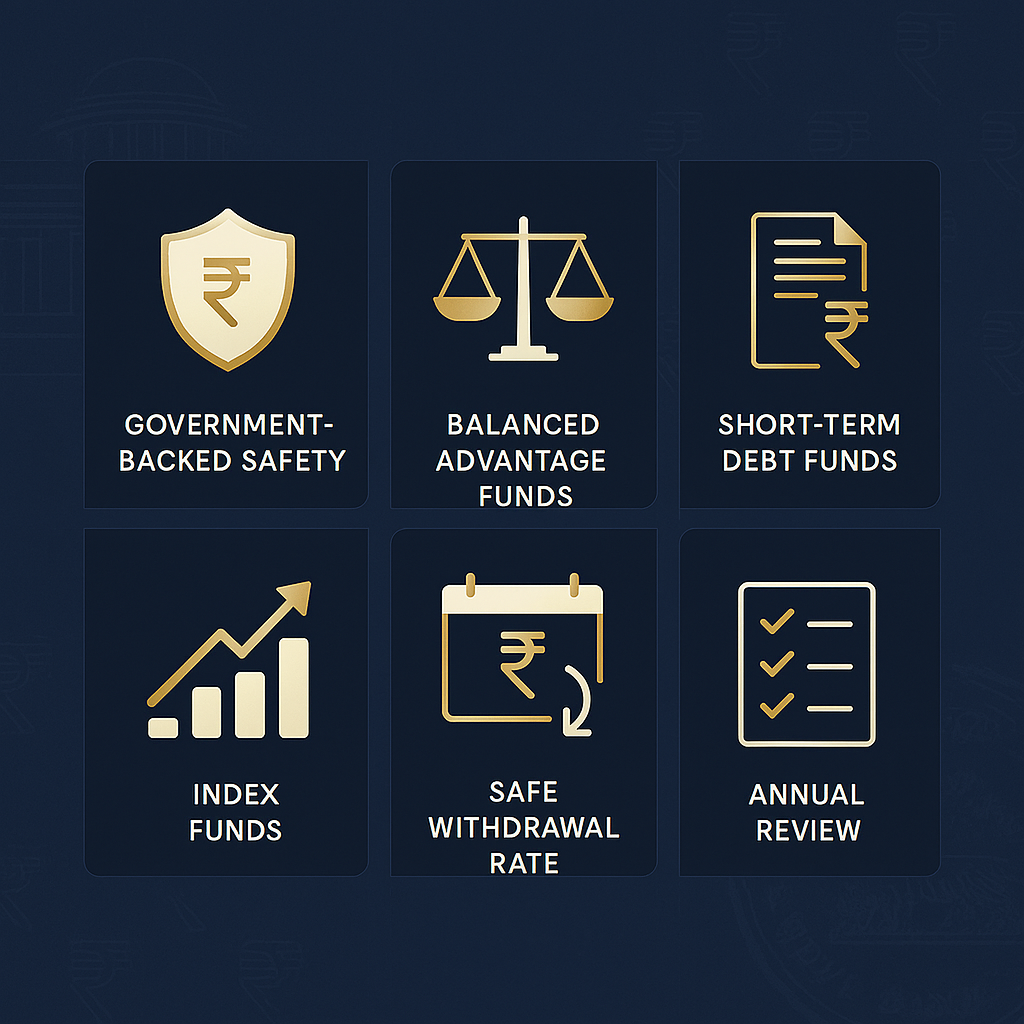
Bottom line: A diversified approach — blending government schemes for stability, equity for growth, and smart tax choices — gives your Rs. 1 crore the best chance of lasting 30+ years while protecting your lifestyle along the way.