

UPI Is Safe. But Fraudsters Are Coming for You Anyway.
India processes over 12 billion UPI transactions every single month. The infrastructure is world-class, government-backed, and genuinely secure. The problem is not the technology — the problem is that scammers have figured out they don’t need to break the system. They just need to break your trust.
Every day, thousands of Indians lose money to UPI fraud. Not because they were careless people. Because fraudsters are extremely good at creating convincing situations — fake urgency, fake authority, fake refunds — that make perfectly intelligent people act against their own interest.
This guide gives you the knowledge to recognise every major scam pattern in India, the 12 rules that protect you from almost all of them, and a clear action plan if something does go wrong.
The Golden Rule — Read This Before Anything Else
If you remember nothing else from this guide, remember this: receiving money through UPI never requires you to enter your PIN. Ever.
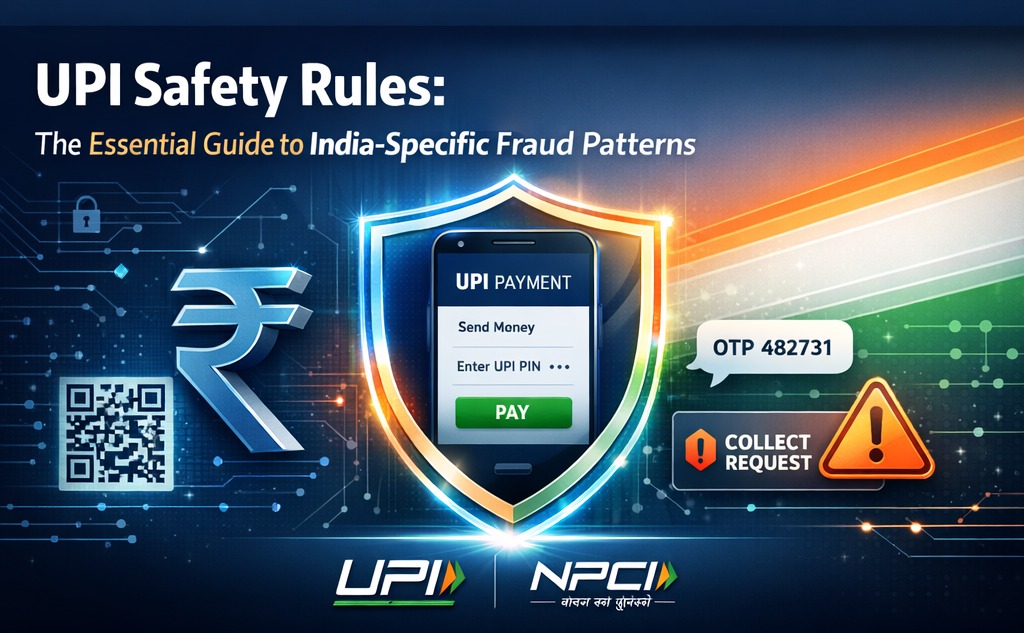
Here is what happens in the most common UPI scam in India. A fraudster sends you a “collect request” — a payment request that arrives in your UPI app. They tell you it is a refund, a cashback, a prize, or money from a buyer. It looks like an incoming payment. You enter your PIN to confirm. The moment you do, money moves out of your account and into theirs. You paid them.
The technology is not broken. You were told the wrong thing about what entering your PIN does. Your PIN authorises a payment from you. It is never required to receive money.
| ✔ Pro Tip: Whenever someone asks you to enter your UPI PIN to “receive” money, hang up immediately and report the number to your bank. No legitimate refund, cashback, prize, or transfer from another person requires any action on the recipient’s side. The money simply arrives. |

Six Fraud Patterns Used Across India Right Now
These are not theoretical scams. They are active, widespread, and specifically designed for Indian users. Knowing them is the most practical form of protection.
A. The OLX and Online Marketplace Scam
You list something for sale online. A buyer contacts you quickly, seems eager, and sends you a “payment request” instead of transferring directly. You assume it is how they pay. You enter your PIN. Your money is gone.
• When you are the seller, you never need to enter your UPI PIN. Your only job is to share your UPI ID or QR code
• Any buyer who asks you to “confirm your account by approving a request” is running this scam
B. The Fake Customer Care Scam
You post a complaint about your bank, UPI app, or wallet on Twitter or a consumer forum. A fake account — sometimes with an official-looking name — replies with a helpline number. You call. They ask you to install AnyDesk, TeamViewer, or QuickSupport for “remote assistance.” Once installed, they see everything on your phone and drain your account.
• No real bank or UPI app ever asks you to install a screen-sharing tool
• Always find customer care numbers from the official app or bank website only
C. The QR Code Scam
A stranger sends you a QR code with a message like “scan this to receive your refund.” Scanning a QR code is always a payment — always. You are paying, not receiving. The moment you scan and confirm, the money leaves your account.
• QR codes take money out of your account. They cannot send money to you
• If someone sends you a QR code to “receive” anything, it is a scam
D. The Fake UPI App Scam
Fraudsters build near-perfect replicas of GPay, PhonePe, BHIM, and Paytm and distribute them via WhatsApp links, suspicious websites, and third-party app stores. These apps look identical but steal your credentials and bank details the moment you log in.
• Only install UPI apps from the official Google Play Store or Apple App Store
• Never install from a link sent via WhatsApp, SMS, or any website
E. The Job, Cashback, and Easy Money Scam
“Earn ₹5,000 a day liking YouTube videos.” “Instant ₹2,000 cashback on your next payment.” “Complete simple tasks and get paid daily.” These messages reach millions of Indians on WhatsApp every day. They always lead to one of two things: a payment request, or a link that captures your UPI credentials.
• If someone offers you money before you have done anything of value, it is a scam
• Legitimate employers do not pay via UPI collect requests
F. The Impersonation and Urgency Scam
The caller claims to be from the police, Income Tax department, electricity board, TRAI, or your bank. Sometimes they claim to be a relative in an emergency. They always create extreme time pressure — “pay in the next 10 minutes or your account gets frozen”, “your connection will be cut tonight.” Under this pressure, people act without thinking.
• Urgency is the weapon. The moment you feel pressured to act immediately, slow down
• Hang up. Call back on a number you already know. Verify independently
| ⚠ Important Note: These six patterns account for the overwhelming majority of UPI fraud in India. The specific details change — new excuses, new apps, new pretexts — but the underlying mechanics are always the same: create a believable reason for you to either enter your PIN to “receive” money, or install something that gives access to your phone. |
The 12 Non-Negotiable UPI Safety Rules
These rules are not optional guidelines. Each one exists because real people lost real money by not following it. Print this list. Share it with your parents. Save it on your phone.
Rule 1 — Never share your UPI PIN with anyone.
Not with your bank. Not with customer care. Not with a family member. Not with anyone. Your PIN authorises money leaving your account. It is yours alone.
Rule 2 — Never approve a collect request you did not initiate.
If a payment request appears in your app and you do not know exactly why it is there, reject it. You are not being rude. You are protecting yourself.
Rule 3 — Never scan a QR code sent by a stranger.
Especially not one that comes with a promise of receiving money. QR codes initiate payments from you.
Rule 4 — Never install screen-sharing apps at someone’s request.
AnyDesk, QuickSupport, TeamViewer — legitimate banks and UPI companies never ask you to install these. If someone does, end the call.
Rule 5 — Never click links about KYC expiry, refunds, or overdue bills.
These links either capture your credentials or install malware. Go directly to your bank’s official app or website for any account-related action.
Rule 6 — Always verify the UPI ID before sending money.
After you type the UPI ID, your app shows the registered name. Read it. One wrong character sends your money to a stranger and recovery is very difficult.
Rule 7 — Use a dedicated UPI account for large transfers.
Keep high-value transactions separate from your everyday spending account. If one account is compromised, the damage is contained.
Rule 8 — Set a daily UPI transaction limit of ₹5,000–₹10,000.
You can raise it when you genuinely need to. But keeping it low by default means that even if something goes wrong, the maximum exposure is limited.
Rule 9 — Lock your UPI app with fingerprint or Face ID.
So that a stolen or borrowed phone cannot be used to access your account without your biometrics.
Rule 10 — Enable transaction alerts for every debit.
SMS and email alerts for every transaction mean you find out within seconds if something goes wrong — not days later when recovery is much harder.
Rule 11 — Update your UPI app only from official stores.
Fake update prompts sent via WhatsApp or SMS are a common delivery mechanism for malware. If your app needs an update, it will tell you inside the app.
Rule 12 — When something feels urgent, stop completely.
Urgency is manufactured. Real banks, real government departments, and real emergencies give you time to think and verify. Whoever is pressuring you to act in the next five minutes is almost certainly a fraudster.
| ✔ Pro Tip: Share these 12 rules with your parents and anyone in your family who uses UPI but may not be fully aware of these patterns. Senior citizens are disproportionately targeted because fraudsters know they are more likely to trust authority and less likely to question urgency. Five minutes of conversation can protect their life savings. |
Red Flags Every Indian UPI User Must Recognise
These specific phrases are used by fraudsters in India every single day. They arrive via phone call, WhatsApp, SMS, and email. If you hear or see any of them, treat it as fraud until proven otherwise.
• “Your KYC is expiring — update it now or your account will be blocked”
• “Your electricity connection will be cut tonight — pay the outstanding amount immediately”
• “Your courier is held at customs — pay a small clearance fee to release it”
• “We are processing your refund — just approve this collect request to receive it”
• “This is a police cybercrime notice — pay the penalty now to avoid arrest”
• “Your family member is in an emergency — transfer money immediately, I will explain later”
• “Your mobile number is linked to illegal activity — your SIM will be blocked in two hours”
These are 100% fraud patterns confirmed across thousands of reported cases in India. No legitimate organisation communicates via urgent WhatsApp messages or unknown phone numbers. No government authority demands immediate UPI payment to avoid legal action.
| ⚠ Important Note: The moment you feel a surge of panic or urgency from any call or message, that feeling itself is the warning sign. Scammers are trained to create exactly that feeling. Recognise it for what it is — a manipulation technique — and use it as your cue to slow down, not speed up. |
What to Do If You Suspect Fraud — The First 30 Minutes
Time is the single biggest factor in UPI fraud recovery. The sooner you act, the higher the chance of getting your money back. Act within 30 minutes if at all possible.
Step 1 — Call your bank’s fraud helpline immediately
Ask them to flag the transaction and block your UPI access temporarily. Every major bank has a 24-hour fraud helpline. Find this number now and save it in your phone before you ever need it.
Step 2 — Report on the NPCI portal
Go to the NPCI website and raise a dispute under the UPI/IMPS section. This creates an official record with the payment system authority and initiates a formal investigation.
Step 3 — File a complaint at cybercrime.gov.in
This is the national cybercrime reporting portal. Filing here creates a legal record, triggers law enforcement involvement, and significantly improves your chances of recovery through the banking dispute mechanism.
Step 4 — Change your UPI PIN and app lock immediately
Even before you finish the steps above, change your UPI PIN. If your device was compromised, this limits what the fraudster can do with continued access.
| ✔ Pro Tip: Save your bank’s fraud helpline number in your phone right now — before you ever need it. In a stressful situation, having to search for the number costs precious minutes. Also save the cybercrime helpline: 1930, which is the national cybercrime reporting hotline in India. |
Final Word — Awareness Is Your Strongest Protection
UPI is genuinely one of the most advanced payment systems in the world. The NPCI, the RBI, and India’s banks have built robust security at every layer of the infrastructure. Fraud does not happen because the system is weak.
It happens because scammers exploit four very human things: trust in authority, panic under pressure, unfamiliarity with how UPI actually works, and the natural instinct to act quickly when someone tells you there is an emergency.
Every single rule in this guide addresses one of those four things. Follow them and you remove almost all of your vulnerability. Not because you become suspicious of everyone — but because you know exactly how a legitimate transaction works, and you recognise immediately when something does not fit that pattern.
| ✔ Pro Tip: Review these rules once a year. Fraud patterns evolve. New pretexts appear. New app names are used. The mechanics stay the same, but the specific scripts change. An annual five-minute refresh keeps your awareness current. |
Quick Reference — Key Portals and Helplines
| Item | Where to Go |
| Cybercrime Helpline (call) | 1930 — national cybercrime reporting hotline, 24×7 |
| Report UPI fraud online | cybercrime.gov.in — National Cyber Crime Reporting Portal |
| NPCI UPI/IMPS dispute | npci.org.in — raise dispute under Payments / UPI |
| Block UPI via your bank | Call your bank’s 24-hour fraud helpline — find the number in your banking app |
| UPI app — Google Pay | Download only from play.google.com — never from a link |
| UPI app — PhonePe | Download only from phonepe.com or official app stores |
| UPI app — BHIM | Download only from bhimupi.org.in or official app stores |
| Change UPI PIN | Open your UPI app → Settings → Change UPI PIN |
Key Takeaways:
- UPI is safe — fraud happens because scammers exploit human trust, not technical weakness
- The Golden Rule: receiving money never requires your PIN. If someone says it does, it is a scam
- Six fraud patterns cover almost all UPI crime in India — know them and you recognise attacks instantly
- Twelve rules eliminate most of your vulnerability — share them with your family
- If fraud happens, call your bank within 30 minutes, report on cybercrime.gov.in, and change your PIN immediately
- Awareness does not make you paranoid — it makes you a much harder target