

India received over USD 120 billion in remittances in 2024 — the largest inward remittance flow in the world. NRIs are the foundation of that number, and fraudsters know it. Fake remittance apps, phishing platforms, WhatsApp agents, and social engineering scams have all been designed specifically around how NRIs send money home: routinely, often under time pressure, and sometimes through informal channels that promise lower fees.
The protection does not require sacrificing speed or paying more. Regulated fintech platforms like Wise and Remitly are consistently cheaper than traditional bank transfers and faster than informal channels. This guide gives you every safe option explained in full, a country-by-country platform guide, a cost comparison, a worked NRO-to-NRE repatriation walkthrough, and a 10-point pre-transfer checklist.
The Golden Rule — Regulated, Verifiable, and Directly Accessible
Every safe remittance channel has three things in common: it is regulated by a financial authority in both the sending and receiving country, it is directly accessible without an intermediary, and it is verifiable on an official government portal.
Wise is registered with the FCA (UK) and compliant with RBI’s authorised payment system requirements. Remitly, Xoom, and Western Union are licensed money transfer operators regulated by FinCEN in the US, FCA in the UK, DFSA in the UAE, and ASIC in Australia. ICICI Money2India, HDFC RemitNow, and SBI Express Remit are operated directly by RBI-regulated Indian banks. SWIFT bank transfers are regulated at both ends and insured through the banking system.
Every other channel — WhatsApp agents, Telegram groups, social media zero-fee offers, unknown apps, crypto off-ramps — fails at least two of these three tests. That is not a coincidence. It is by design. Unregulated channels are unregulated because regulation creates accountability, and accountability is what fraudsters are avoiding.
| ✔ Pro Tip: Check any remittance platform on RBI’s authorised payment systems list before using it for the first time: rbi.org.in → Payments → Authorised Payment Systems.International platforms are regulated by their home country authority (FCA, FinCEN, AUSTRAC, MAS). You can verify registration directly on each regulator’s public register. |
All Channels at a Glance — Cost, Speed, Safety, and Recall
This table covers every available channel including a realistic cost estimate, typical speed, best transfer size, and whether a recall is possible if fraud is discovered. The last row is included as a warning.
| Channel | Typical Cost | Speed | Best Amount | Safety | Recall if Fraud |
| SWIFT Bank Transfer | USD 15–40 + FX spread | 1–3 days | ₹5 lakh+ | Highest | Yes — via SWIFT chain |
| Wise | 0.3–1.5% of amount | Minutes–1 day | ₹10K–5 lakh | High | Platform dispute process |
| Remitly | USD 2–5 fixed fee | Minutes–24 hrs | ₹10K–3 lakh | High | Guaranteed delivery or refund |
| ICICI Money2India | 0.5–1% + rate margin | Same day to 1 day | ₹10K–2 lakh | Very High | Bank-backed: strong |
| HDFC RemitNow | Similar to ICICI | Same day to 1 day | ₹10K–2 lakh | Very High | Bank-backed: strong |
| SBI Express Remit | Similar to ICICI | 1–2 days | ₹10K–2 lakh | Very High | Bank-backed: strong |
| NRE/NRO Internal Transfer | Nil–minimal | Same day | Any amount | Highest | N/A — within your own accounts |
| FCDD (Demand Draft) | Low–medium flat fee | 7–15 days | Large one-off | Highest | Physical instrument — traceable |
| Indian Bank Branch Abroad | Medium–high | 1–2 days | ₹2 lakh+ | Very High | Bank-to-bank recall pathway |
| WhatsApp/Telegram agents | ‘Zero fee’ (misleading) | Claimed instant | Any — all at risk | None | No recourse. No recovery. |
| ✔ Pro Tip: The ‘Recall if Fraud’ column is the most important column in this table for NRIs transferring large amounts.SWIFT transfers and Indian bank-originated transfers have the strongest recall pathways. Wise and Remitly have documented dispute and refund processes. The informal channels in the last row have none — once the money is gone, it is gone. |
SWIFT Bank Transfers — Maximum Safety and the Strongest Recall Pathway
SWIFT is the gold standard for large, documentation-critical transfers. For NRIs sending property payments, investment amounts, or large family support above ₹5 lakh, SWIFT is the appropriate channel — not because it is cheapest, but because it provides the strongest paper trail, the most effective fraud recall pathway, and the least intermediary involvement.
| Aspect | Detail |
| How it works | Your foreign bank sends a SWIFT message to a correspondent bank, which forwards it to your Indian bank. The funds credit to your NRE or NRO account. The chain is fully documented and traceable at every hop. |
| Typical fee structure | Sending bank fee: USD 15–40. Correspondent bank fee (sometimes deducted from the amount): USD 10–25. Exchange rate margin: 0.5–1.5% above the mid-market rate. Total cost on a USD 5,000 transfer is typically USD 30–70. |
| Foreign bank SWIFT vs Indian bank SWIFT | Initiating via your local foreign bank (HSBC, Barclays, Chase, etc.) often costs more than using an Indian bank’s foreign branch (SBI New York, ICICI UK, HDFC UAE). Indian bank SWIFT typically has lower fees and direct NRE/NRO credit. |
| Recall process | If fraud is reported within 2–6 hours of initiation, your bank can send a SWIFT recall message. The correspondent bank freezes the transfer pending investigation. Not guaranteed, but significantly more effective than any unregulated channel. |
| Best for | Property payments, large investments, lump-sum family support, any transfer where full documentation and a recall pathway are required. |
| Safety steps | Verify SWIFT code at swift.com. Verify IFSC at rbi.org.in. Initiate only from your bank’s official net banking or NRI desk. Screenshot the confirmation with the full transaction reference number. |
| ⚠ Important Note: There is an important distinction between initiating a SWIFT transfer via your local foreign bank (Chase, HSBC, Barclays, NAB) vs via an Indian bank’s foreign branch or correspondent (SBI New York, ICICI UK, HDFC UAE).Indian bank SWIFT typically has: lower sending fees, a direct credit to your NRE/NRO account without intermediate bank deductions, and a more responsive fraud reporting process because the recipient bank is the same institution.If you hold an NRE/NRO account with SBI, ICICI, HDFC, or Axis, check whether they have a branch or correspondent partner in your country before using a foreign bank SWIFT. |
Regulated Online Platforms — Cost Comparison and Country Guide
For small-to-medium transfers, regulated fintech platforms consistently beat traditional bank SWIFT on both cost and speed. The cost difference is significant over a year of regular transfers — money that stays in your pocket rather than disappearing as bank margin.
How much do NRIs actually lose to poor FX rates? Here is a realistic comparison across transfer amounts for 12 transfers per year:
| Transfer Amount (USD) | Bank SWIFT (est. cost) | Wise (est. cost) | Remitly (est. cost) | Annual saving (12 transfers) |
| USD 500 | USD 35–55 (7–11%) | USD 3–5 (0.6–1%) | USD 3–5 (0.6–1%) | ~USD 360–600 saved per year |
| USD 1,000 | USD 40–60 (4–6%) | USD 5–8 (0.5–0.8%) | USD 4–6 (0.4–0.6%) | ~USD 400–660 saved per year |
| USD 5,000 | USD 55–85 (1.1–1.7%) | USD 18–35 (0.4–0.7%) | USD 10–25 (0.2–0.5%) | ~USD 240–900 saved per year |
| USD 10,000 | USD 70–120 (0.7–1.2%) | USD 35–65 (0.35–0.65%) | USD 20–50 (0.2–0.5%) | ~USD 240–840 saved per year |
The table above uses estimated figures that reflect typical market conditions. Actual rates vary daily. The key insight: the difference between using a bank SWIFT and using Wise or Remitly for regular medium-size transfers can easily exceed USD 500–1,000 per year, with no reduction in safety.
Which platforms are available from your country:
| Resident Country | Best Low-Cost Platform | Best Fast Platform | Indian Bank Option | Notes |
| USA | Wise, Instarem | Remitly Express, Xoom | SBI Express Remit, ICICI Money2India, HDFC RemitNow | All major platforms available. Widest choice. |
| United Kingdom | Wise (mid-market rate) | Remitly Express | ICICI Money2India, HDFC RemitNow, SBI Express Remit | FCA-regulated platforms. Wise headquartered in UK. |
| UAE / Gulf | Wise, Al Ansari Exchange (for cash) | Remitly, Xoom | ICICI Money2India, HDFC RemitNow, SBI Express Remit | Remittance heavily used. UAE Exchange also available. |
| Canada | Wise, Instarem | Remitly Express | ICICI Money2India, HDFC RemitNow | FINTRAC-regulated platforms. Bank fees higher. |
| Australia | Wise, Instarem | Remitly Express | SBI Express Remit, ICICI Money2India | AUSTRAC-regulated. Wise and Instarem have strong APAC coverage. |
| Singapore | Wise, Instarem | Remitly, Xoom | ICICI Money2India, DBS Remit | MAS-regulated. Instarem headquartered in Singapore. |
| New Zealand | Wise | Remitly | SBI Express Remit | Fewer Indian bank options. Wise recommended for regular transfers. |
| ✔ Pro Tip: Set a rate alert on Wise or Remitly for your regular transfer amount. Both apps notify you when the INR/USD (or GBP, AED, CAD, AUD, SGD) rate crosses a threshold you set.This is how experienced NRI remitters time their transfers without obsessively watching exchange rates — the app tells you when the moment is right. |
NRE/NRO Transfers and the Form 15CA/CB Repatriation Process
Transfers within your own NRE and NRO accounts, or from a foreign account to your NRE via your Indian bank’s international service, involve no third party and carry essentially zero fraud risk. Everything happens within the regulated Indian banking system.
NRE account: Foreign-earned income and international remittances. Fully repatriable. Interest tax-free in India. No limit on repatriation abroad.
NRO account: Indian-source income — rent, dividends, pension, capital gains from Indian assets. Taxable in India. Repatriation subject to USD 1 million annual limit and Form 15CA/CB documentation.
Repatriating money from your NRO account abroad requires filing Form 15CA and Form 15CB. Many NRIs find this process opaque. Here is exactly how it works:
| Step | What to Do | Who Does It | Where |
| Step 1 | Obtain Form 15CB: Engage a Chartered Accountant (CA) registered in India. The CA certifies that the remittance is not taxable in India, or that the appropriate tax has been deducted. | Your India-registered CA | CA’s office; can be done remotely via email and courier of signed documents |
| Step 2 | File Form 15CA online: Log in to the Income Tax portal (incometax.gov.in) and file Form 15CA (Part C for transfers above ₹10 lakh, Part A for lower amounts). Upload the CA’s Form 15CB. | You (the NRI) | incometax.gov.in → e-File → Income Tax Forms → Form 15CA |
| Step 3 | Submit to your bank: Submit the filed Form 15CA acknowledgement and the original signed Form 15CB to your bank’s NRI desk (in person or via the NRI portal). | You (the NRI) | Your bank’s NRI desk or NRI banking portal |
| Step 4 | Bank processes the repatriation: The bank verifies the documents and processes the outward remittance from your NRO account to your foreign account. | Your bank | Processed within 2–5 business days after document submission |
| ✔ Pro Tip: The Form 15CB requires a CA registered in India. If you do not have one, your Indian bank’s NRI desk can typically refer you to a panel CA who handles this remotely.The entire process — from engaging the CA to the bank processing the repatriation — typically takes 5–10 business days for a first-time filing, and 2–5 days for repeat filings with the same CA. |
Foreign Currency Demand Drafts and Indian Bank Branches Abroad
These two methods are the most underused by NRIs and among the safest for specific scenarios. They are not the fastest or cheapest options, but for institutional payments and large property transactions they provide a level of documentation that no digital channel can match.
| Feature | Foreign Currency Demand Draft | Indian Bank Branch Abroad |
| Best for | Education fee payments to institutions, property stamp duty, large payments where the institution requires a physical instrument | Large transfers above ₹10 lakh, NRIs who prefer in-person initiation, situations where Indian bank SWIFT fees are lower |
| Speed | 7–15 business days for delivery and clearance. Not suitable for urgent transfers. | 1–2 business days. Comparable to standard SWIFT. |
| Cost | Low–medium flat fee. No FX spread beyond the bank’s standard rate. | Medium–high. Lower than foreign bank SWIFT in many cases. |
| Fraud protection | Complete. A physical bank-issued instrument cannot be digitally intercepted or diverted. | Very high. Bank-to-bank transfer with direct NRE/NRO credit. |
| Available from | Any bank with international services in your resident country | SBI: USA, UK, UAE, Canada, Singapore, Australia. ICICI, HDFC, Axis: through correspondent partnerships in major NRI markets. |
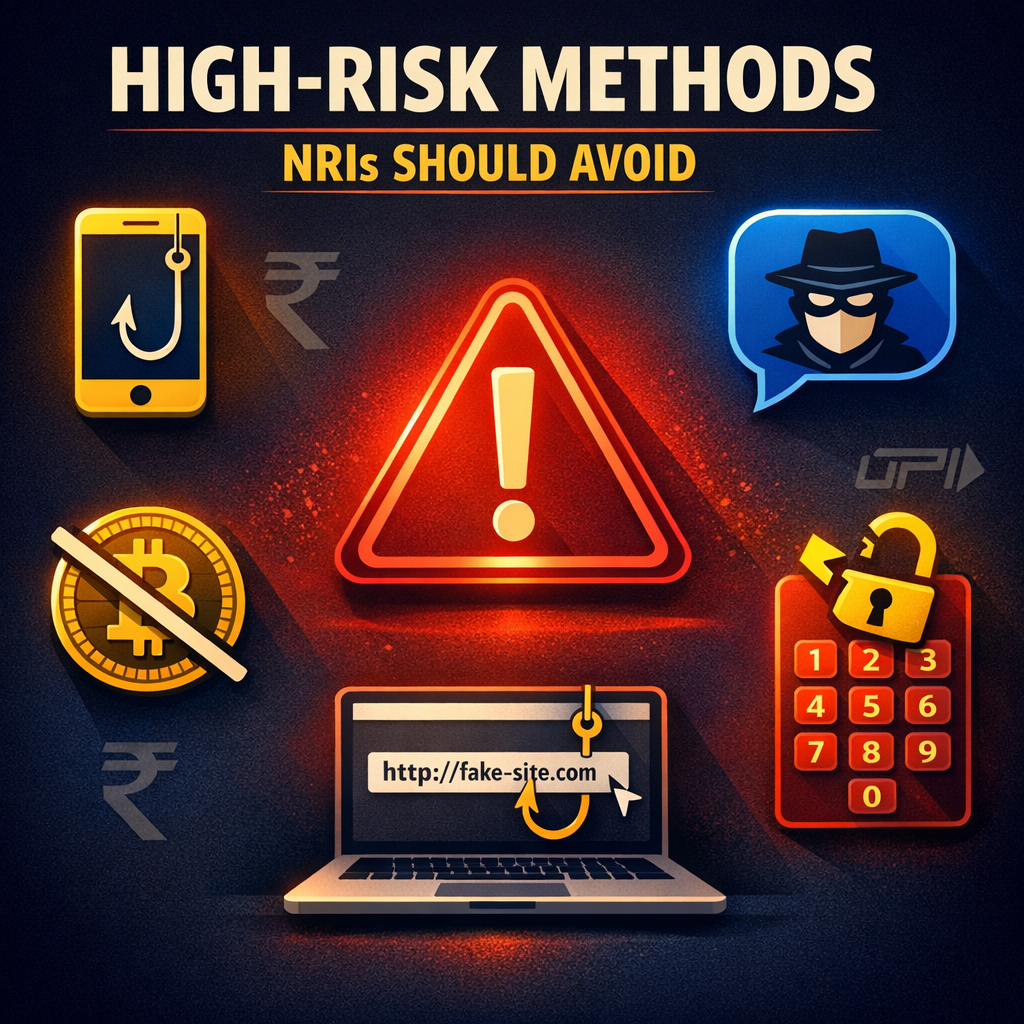
High-Risk Methods to Avoid — The Fraud Mechanics Explained
These six methods are responsible for the majority of NRI remittance fraud. Understanding the mechanics of each one — not just the label — is what allows you to recognise new variants as they appear.
| High-Risk Method | The Fraud Mechanics | Safe Alternative |
| Unknown remittance apps | Built to look identical to Wise, Remitly, or ICICI Money2India. Captures login, card details, and OTPs on first use. Listed on obscure app stores or sent as APK links via WhatsApp. | Google Play Store / Apple App Store only. Verify exact developer name before installing. |
| WhatsApp / Telegram ‘agents’ | Operate via social proof: show fake screenshots of successful past transfers. Collect money to a personal account and disappear, or make one successful transfer to build trust before the large fraud. | Wise, Remitly, ICICI Money2India, HDFC RemitNow, or bank SWIFT — all directly accessible without an intermediary. |
| Social media zero-fee ads | Run by unregistered operators. Zero-fee is recovered via a manipulated exchange rate (you lose on FX what you ‘save’ on fees) or the transfer is simply stolen. | Compare actual post-fee, post-FX amounts across Wise and Remitly. The total received in India is what matters. |
| Crypto-to-INR transfers | Involves unregulated crypto exchanges and informal fiat off-ramps. FEMA non-compliant. Cannot be deposited into NRE accounts. No recourse if the off-ramp disappears. | RBI-approved channels only. No FEMA-compliant pathway exists for crypto-to-NRE/NRO transfers. |
| Personal account transfers to ‘agents’ | Money to a personal account has zero recovery pathway. There is no bank fraud claim, no SWIFT recall, no regulatory complaint route that applies to a voluntary transfer to an individual’s personal account. | All remittances go directly to the verified recipient’s bank account or to a regulated platform. |
| Sharing OTPs on support calls | Fraudsters call posing as Wise, Remitly, or bank support. Ask for OTP to ‘verify your identity’ or ‘release your transfer.’ The OTP authorises a transaction from your own account. | No support team at any regulated platform ever needs your OTP. Hang up and call official support directly. |
| ⚠ Important Note: The zero-fee offer deserves a specific note on economics. Every legitimate remittance business has compliance costs: AML monitoring, KYC verification, regulatory reporting, fraud insurance, and customer support. These cannot be funded by zero fees.A zero-fee offer either hides the cost in an inflated exchange rate (you lose more on FX than you save on fees), or the operator has no compliance infrastructure at all because they have no regulatory obligation.Either way, you are worse off than using Wise or Remitly — in money, in safety, or both. |
Decision Guide — The Right Channel for Every Scenario
Use this table to select the right channel for your specific need. The right answer genuinely changes based on amount, urgency, purpose, and whether documentation is required.
| Your Scenario | Best Method | Why |
| Property payment or legal fee | SWIFT or FCDD | Maximum documentation trail. FCDD is a bank-issued instrument that cannot be digitally intercepted. SWIFT provides a recall pathway if fraud is discovered. |
| Monthly family support (₹20,000–₹1 lakh) | ICICI Money2India, HDFC RemitNow, or Wise | Low cost, direct NRE/NRO credit, automation available. Standing instructions eliminate the need to log in each month. |
| Urgent transfer needed today | Remitly Express or Xoom | Delivery in minutes to hours. Guaranteed exchange rate at booking. Bank deposit direct to India. |
| Large investment (₹10 lakh+) | SWIFT via Indian bank branch abroad | Lower fees than foreign bank SWIFT. Direct NRE credit. Bank-assisted recall if needed. Strong documentation. |
| Education fee to an institution | FCDD or SWIFT | Institutional payments need a paper trail. FCDD is standard for university fee payments abroad. SWIFT works for direct bank-to-bank institutional transfers. |
| Regular small transfers (₹10,000–30,000) | Wise | Mid-market rate. Low percentage fee. Automation via scheduled transfers. No minimum amount. |
| Moving money from NRO to abroad | NRO → NRE transfer + SWIFT | File Form 15CA/CB first. Convert NRO to NRE via bank. Then repatriate via SWIFT. Fully FEMA-compliant. |
| Testing a new platform for the first time | Wise or Remitly with a small amount | Both offer transparent fees and a guaranteed-delivery-or-refund policy. Test with ₹10,000–20,000 first before using for large transfers. |
| ✔ Pro Tip: The most practical setup for most NRIs: maintain one Indian bank NRI service account (ICICI Money2India or HDFC RemitNow) and one fintech account (Wise). This covers 95% of all remittance scenarios without needing to evaluate options each time.Use the Indian bank service for regular standing instructions to NRE/NRO. Use Wise for ad-hoc transfers where you want to compare rates or need flexibility on the delivery timing. |
The 10-Point Pre-Transfer Safety Checklist
Run this checklist before every transfer. The total time is under three minutes. Steps 1 and 8 — video call to verify recipient details, and screenshot of the confirmation — are the two that most directly determine whether fraud is preventable and whether it is recoverable.
| # | Before You Transfer | Exactly How to Do It | Prevents |
| 1 | Confirm recipient details via video call | Call the recipient at a number you independently know. Confirm name, account number, and IFSC on camera for transfers above ₹50,000. | Account number diversion fraud |
| 2 | Type the platform URL manually | wise.com, remitly.com, money2india.com — never click a link from any message. Check every character of the domain. | Phishing site credential capture |
| 3 | Verify SWIFT and IFSC codes independently | swift.com for SWIFT codes. rbi.org.in for IFSC codes. Do not use codes provided by the sender or agent. | Fraudulent code substitution |
| 4 | Check 2FA is active on the platform | Platform Settings → Security → Two-Factor Authentication. App-based (not SMS) wherever available. | Account takeover with correct password |
| 5 | Use mobile data, not public Wi-Fi | Turn off Wi-Fi and use mobile data before opening any remittance app or banking portal. | Session interception on open networks |
| 6 | Enable biometric login on the remittance app | Face ID or fingerprint as primary. Disable PIN bypass for the app if that option exists. | Unauthorised transfer on unlocked device |
| 7 | Know your daily transfer limit before you need it | Check the limit in your bank’s app and on the platform before initiating. Request a limit increase in advance if needed. | Blocked transfer at a critical moment |
| 8 | Screenshot the full transfer confirmation | Save: transaction reference, timestamp, recipient name, account, amount, exchange rate. Store in a secure vault — not gallery. | No evidence for dispute or recall |
| 9 | Monitor the recipient’s account for the credit | Confirm the credit arrives within the stated timeframe. Report immediately if it does not. | Delayed fraud detection |
| 10 | Update OS and app before large transfers | Install all pending updates. Outdated apps have known, exploitable security vulnerabilities. | Malware credential capture |
| ✔ Pro Tip: Steps 1 and 8 are non-negotiable for any transfer above ₹50,000.Step 1 (video call) prevents the most expensive fraud pattern: fake account change requests from impersonators. Step 8 (screenshot confirmation) is the only evidence that supports a SWIFT recall or platform dispute. Without a transaction reference number, recovery is significantly harder. |
What to Do If a Transfer Goes Wrong — Six Steps in 30 Minutes
SWIFT recalls and platform refunds are time-sensitive. The window is measured in hours, not days. Act immediately when you suspect a transfer has gone to the wrong account.
| Step 1 | Contact your bank’s international fraud department immediately and request a SWIFT transfer recall. Provide your transaction reference number, amount, and recipient details. SWIFT recalls are most effective within the first 2–6 hours of initiation. After 24 hours the window closes significantly. |
| Step 2 | Contact the remittance platform’s official fraud team via their official website only. Wise: wise.com/help. Remitly: remitly.com/help. Western Union: westernunion.com/report-fraud. ICICI: call +91-22-33667777. Use only contacts from the official website — not from any message you received. |
| Step 3 | File a complaint at cybercrime.gov.in and call 1930. UK: Action Fraud at actionfraud.police.uk. USA: ic3.gov. UAE: ecrime.ae. Australia: scamwatch.gov.au. Each jurisdiction’s report creates a legal record and supports the bank recall process. |
| Step 4 | If you know the Indian bank the funds were sent to, call their fraud helpline immediately. Indian banks can freeze mule accounts if notified quickly. Provide the account number, IFSC, and transaction reference. |
| Step 5 | Preserve all evidence: screenshots of all communications, the platform URL you used, the transaction confirmation, any phone numbers or email addresses that contacted you. This is required for every formal complaint and recovery process. |
| Step 6 | Change your password, 2FA, and email password on any platform you accessed during or before the fraud. If you shared an OTP with anyone, treat the account as compromised and rotate all credentials immediately. |
| ✔ Pro Tip: Save these contacts before your next transfer — not after something goes wrong: your bank’s international fraud helpline, your remittance platform’s fraud contact (from their official website), and 1930.In a stressful fraud situation, five minutes spent searching for a contact number is five minutes the fraudster is moving money further away from a recall. |
Quick Reference — Key Portals, Platforms, and Helplines
| Item | Portal / Contact |
| India Cybercrime Helpline | 1930 — 24×7 |
| Report remittance fraud (India) | cybercrime.gov.in |
| RBI authorised payment operators | rbi.org.in → Payments → Authorised Payment Systems |
| Verify SWIFT codes | swift.com → BIC/SWIFT Code Lookup |
| Verify IFSC codes | rbi.org.in → IFSC Search |
| Wise official website | wise.com | Fraud: wise.com/help → Security |
| Remitly official website | remitly.com | Support: remitly.com/help |
| Xoom official website | xoom.com |
| Instarem official website | instarem.com |
| Western Union (official) | westernunion.com | Fraud: westernunion.com/report-fraud |
| ICICI Money2India | money2india.com | NRI helpline: +91-22-33667777 |
| HDFC RemitNow | hdfcbank.com → NRI Banking → RemitNow | +91-22-61606161 |
| SBI Express Remit | sbiexpressremit.com | +91-80-26599990 |
| Form 15CA/CB filing | incometax.gov.in → e-File → Income Tax Forms → Form 15CA |
| UK: Action Fraud | actionfraud.police.uk | 0300 123 2040 |
| USA: Internet Crime Complaint | ic3.gov |
| UAE: Dubai Police eCrime | ecrime.ae |
| Australia: ACCC Scamwatch | scamwatch.gov.au |
Key Takeaway
- Sending money to India is genuinely safe when you use regulated, verifiable channels. For most NRIs, the right combination is straightforward:
- SWIFT or Indian bank branch for large, property, and investment transfers where documentation and a recall pathway matterWise or Instarem for cost-efficient regular or medium-size transfers — mid-market rates, low percentage fees, full transparency
- Remitly Express or Xoom when speed is the priority and same-day or next-day credit is required
- ICICI Money2India, HDFC RemitNow, or SBI Express Remit for regular NRE/NRO credits with standing instructions and direct bank integration
- NRE/NRO internal transfers and FCDD for repatriation and institutional payments requiring the highest-level paper trail
- The difference between the top three safe channels and an informal WhatsApp agent is not just safety. On a USD 1,000 monthly transfer, you save USD 400–600 per year by using a regulated fintech platform over a traditional bank — and you save everything if the agent turns out to be a fraudster.
- Your money is hard-earned. Use channels that earn it the same respect.