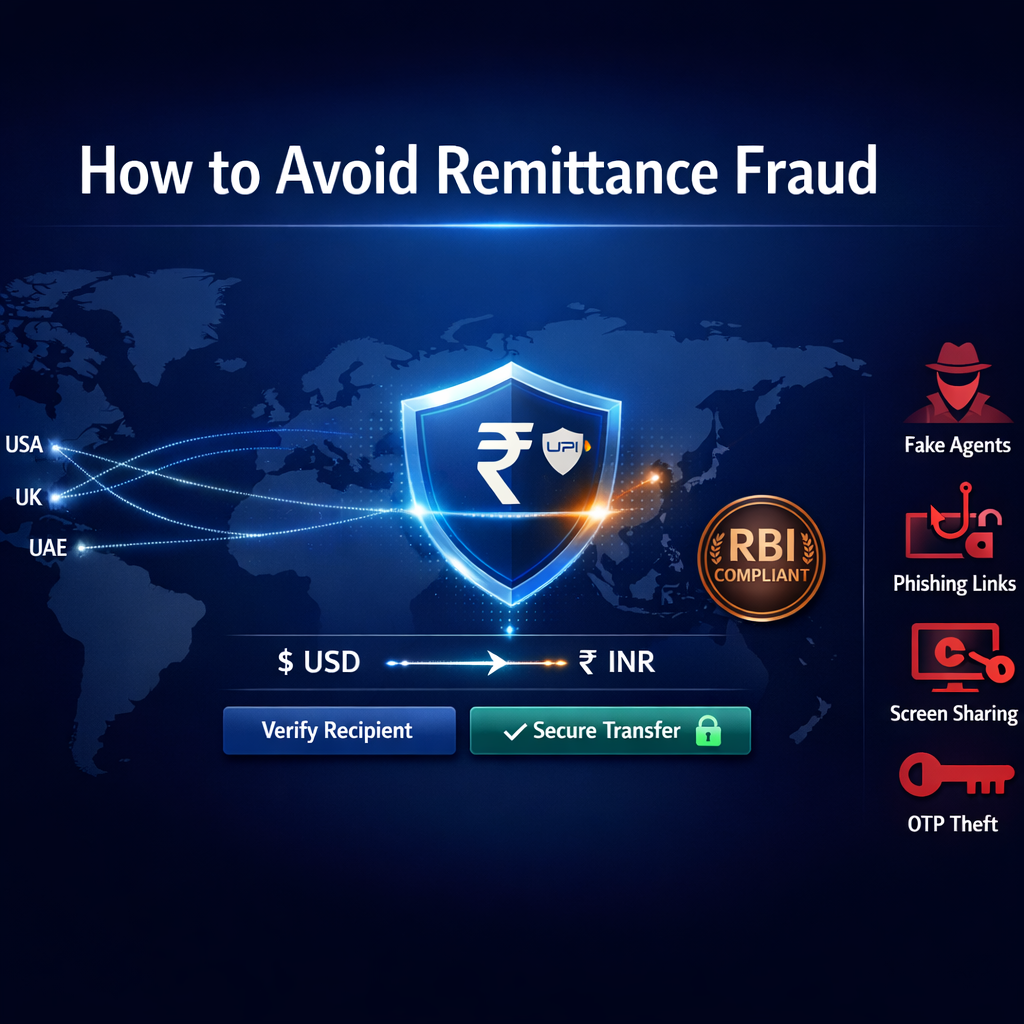
AVOID REMITTANCE FRAUD – The 2026 Protection Guide for NRIs and Global Indians
Reading Time 21 min
Remittance fraud is rising because fraudsters understand something important about how NRIs send money to India: transfers are large, they are often made under emotional pressure — a family emergency, education fees, a property payment — and they increasingly happen through informal channels that promise speed and lower fees. These three factors together create the ideal conditions for fraud.
The protection is not complicated. It comes down to three principles applied without exception: use only regulated channels, verify every detail independently, and block all unofficial intermediaries entirely. This guide gives you everything you need to apply all three — with specific platforms, checklist steps, and a decision table for the scenarios where fraud most commonly occurs.
The Golden Rule — Three Principles That Prevent Almost All Remittance Fraud
If you remember nothing else from this guide, remember this: if the remittance method is not RBI-regulated and verifiable on an official portal, it is unsafe. No exception.
Principle 1 — Regulated channels only: Bank SWIFT, ICICI Money2India, HDFC RemitNow, SBI Express Remit, Wise, Remitly, Xoom, and Western Union official. These are the complete list of safe options for NRIs sending money to India. Every other channel — regardless of how convenient, how cheap, or how trusted the person recommending it — carries significant risk.
Principle 2 — Verify everything independently: The URL, the recipient’s account number, the SWIFT code, and the platform’s registration. Do not rely on information provided by the person or platform you are transacting with. Verify on the official portal before every transfer.
Principle 3 — Block all unofficial intermediaries: WhatsApp agents, Telegram groups, zero-fee social media offers, and unknown apps. The moment someone other than a regulated platform inserts themselves into your transfer chain, the money is at risk.
✔ Pro Tip: The most common emotional trigger in remittance fraud is urgency. A family emergency, a payment deadline, a limited-time rate — the pressure to act faster than you can verify.The safest response to any urgency around a transfer is to slow down, not speed up. Regulated channels process transfers within 24–48 hours at most. If the urgency requires something faster through an unofficial channel, treat the urgency itself as the fraud.
The Five Fraud Patterns Targeting NRIs in 2026 — With Real Trigger Phrases
These five patterns account for the overwhelming majority of NRI remittance fraud cases. Each one exploits a specific vulnerability — the desire for lower fees, the trust placed in familiar names, the fear of a compliance issue, or the urgency of a family emergency. Knowing the pattern and the trigger phrase means you recognise the attack the moment it starts.
Pattern
How It Targets NRIs
Red Flag Trigger Phrase
Instant Give-Away
Fake WhatsApp / Telegram remittance agents
Claim to offer zero-fee or instant transfers to India. Use Indian names, fake RBI certificates, or stolen bank IDs. Collect money and disappear.
“Sir, we are RBI-approved. Send USD to this personal account.”
RBI never approves personal account remittance. No legitimate channel operates via WhatsApp or Telegram.
Fake currency conversion deals
Offer unrealistically high INR rates to attract large transfers. Ask for an upfront deposit to ‘lock in the rate.’ Send fake screenshots of successful transfers.
“Rate is ₹86 today — bank is only giving ₹83. Transfer now to lock it.”
No unregulated broker can offer a rate consistently above the interbank rate. No GST invoice = not a registered business.
Phishing websites mimicking remittance platforms
Near-identical replicas of Wise, Remitly, Xoom, ICICI Money2India, HDFC RemitNow. Capture login credentials, card details, and passport scans.
“Your transfer has failed. Log in to retry.” (link in email or SMS)
URL has a spelling variation, extra character, or wrong domain suffix. Type official URLs manually, never click links.
Account takeover via OTP or screen sharing
Fraudster poses as bank or remittance platform support. Asks for OTP, CVV, or asks you to install AnyDesk/TeamViewer. Takes control and initiates transfers.
“We need to verify your KYC. Please share your screen.”
No bank or regulated remittance platform ever asks for your OTP, CVV, or screen access. Hang up immediately.
Fake recipient verification / account change
Scammer impersonates the Indian recipient (family member, property seller, university, hospital). Claims account details have changed and redirects the transfer to a mule account.
“My bank account has changed. Please send to this new number instead.”
Always verify account changes via a direct video call to the recipient at a number you already know. Never update details based on a message alone.
⚠ Important Note: Pattern 5 — the fake recipient account change — is the most financially devastating and the least technically sophisticated. It requires no hacking, no fake website, and no OTP theft. A fraudster simply intercepts your communication with the real recipient (or impersonates them) and asks you to update the account details.The fix is absolute: never update a recipient’s bank account or IFSC code based on a message, email, or call. Always verify via a direct video call to the recipient at a number you already possess independently of the conversation about the transfer.
Every Safe, RBI-Regulated Remittance Channel — With Recommended Use Cases
These are the only channels NRIs should use to send money to India. Each is RBI-regulated, internationally licensed, and has a documented fraud reporting and recovery process. Choose between them based on amount, speed, and recipient type — not based on fees alone.
Channel
Best Used For
Key Feature
Where to Access
Bank-to-bank SWIFT transfer
Large transfers (property, education fees, major investments). Highest safety.
Traceable, insured, fully FEMA compliant. Bank can assist with recall if fraud occurs.
FCA/RBI-registered. Mid-market rate. Full transparency on fees before transfer.
wise.com or Wise app
Remitly
Fast or economy transfers. Flexible delivery options (bank/cash/mobile money).
Regulated in multiple jurisdictions. Guaranteed exchange rate for the transaction.
remitly.com or Remitly app
Xoom (PayPal)
Fast transfers. Linked to PayPal accounts. Available in many countries.
Licensed money transfer operator. PayPal-backed trust. 24×7 support.
xoom.com or Xoom app
Western Union (official only)
Wide recipient network. Cash pickup option where needed.
Globally regulated. Use only westernunion.com or official app — not third parties.
westernunion.com or WU app
Foreign Currency Demand Draft (FCDD)
Education fees, property stamp duty, very large one-off payments.
Extremely safe. Paper trail. Bank-issued. Best for payments to institutions.
Request at your bank branch or NRI desk
✔ Pro Tip: For transfers above $10,000 or ₹10,00,000, always use bank-to-bank SWIFT or a Foreign Currency Demand Draft. The higher level of documentation and the bank-to-bank chain creates a recovery pathway that informal channels and even some third-party platforms cannot match.For recurring smaller transfers to NRE/NRO accounts, ICICI Money2India, HDFC RemitNow, and SBI Express Remit offer the best combination of safety, speed, and direct NRE/NRO credit without third-party involvement.
The 10-Step Anti-Fraud Checklist — Run This Before Every Transfer
This checklist takes under three minutes to run and prevents the vast majority of remittance fraud. Make it a habit for every transfer, regardless of the amount or how familiar the platform is.
#
Checklist Step
How to Do It
What It Prevents
1
Verify the platform URL manually
Type the official URL directly into your browser. Never click links from emails, SMS, or WhatsApp. Check that the domain matches exactly.
Phishing website fraud
2
Check the SWIFT/IFSC code independently
Verify SWIFT codes at swift.com and IFSC codes at rbi.org.in or your bank’s official site. Do not trust codes sent by the ‘agent.’
Fake account redirection
3
Confirm recipient details via video call
Before any transfer above ₹50,000 or $500, call the recipient on a number you already know and confirm account details on camera.
Fake recipient impersonation scam
4
Never share OTP, CVV, or PIN
Not with any caller, support agent, or platform asking via any channel. An OTP authorises a transaction from your account, not a verification of identity.
Account takeover via social engineering
5
Avoid public Wi-Fi during transfers
Use mobile data or home Wi-Fi only for any remittance transaction. If unavoidable, use a reputable paid VPN.
Man-in-the-middle network attacks
6
Enable 2FA on all remittance apps
Use app-based 2FA (Google Authenticator or the platform’s own authenticator) not SMS OTP wherever available.
Account takeover even with correct password
7
Use biometric login on remittance apps
Enable fingerprint or Face ID for all banking and remittance apps. Disable the option to bypass biometric with a PIN in the app settings.
Unauthorised access on an unlocked device
8
Check transfer limits and alerts
Confirm your bank’s daily international transfer limit. Enable real-time alerts for every debit so you know the moment a transfer initiates.
Delayed fraud detection
9
Screenshot every transfer confirmation
Save the transaction reference number, timestamp, recipient details, and amount confirmation for every transfer as a record for dispute resolution.
Inability to raise a recall or dispute
10
Update your OS and banking apps first
Install all pending OS and app updates before initiating any transfer. Known vulnerabilities in outdated apps are actively exploited.
Malware and credential capture via unpatched apps
✔ Pro Tip: Steps 3 and 9 are the two most skipped and the two most valuable in this list.The video call to confirm recipient details (Step 3) takes three minutes and prevents the most expensive single fraud pattern targeting NRIs.The transfer screenshot (Step 9) takes five seconds and is the only evidence that matters in a dispute or recall request. Without a transaction reference number, a bank cannot initiate a recall.
High-Risk Methods You Must Avoid Completely
These seven methods are responsible for the majority of NRI remittance fraud. The common thread is the same in every case: money moves outside a regulated, traceable channel, which means it cannot be recalled, disputed, or recovered.
High-Risk Method
Why It Is Always Unsafe
Safe Alternative
WhatsApp / Telegram ‘agents’
No regulatory oversight, no paper trail, no recourse if money is lost. Accounts can disappear in minutes.
Use Wise, Remitly, ICICI Money2India, HDFC RemitNow, or bank SWIFT.
Social media zero-fee transfer ads
Invariably unregistered operators. The ‘zero fee’ is recovered via a manipulated exchange rate or simply by taking the transfer.
Compare rates on regulated platforms. Small fee differences do not justify using unregulated channels.
Unknown mobile apps not on Play Store / App Store
APK files bypass all security reviews. Fake apps capture login credentials, card details, and OTPs.
Download only from Google Play Store or Apple App Store, verified developer only.
Crypto transfers for Indian expenses
Crypto-to-INR conversion involves unregulated intermediaries in most cases. Completely outside FEMA compliance for NRE/NRO accounts.
Use RBI-approved remittance channels for all India-bound transfers.
Sending money to personal accounts of ‘agents’
Legitimate remittance never goes to an individual’s personal account. This is the defining characteristic of almost every remittance fraud.
Money goes only to official AMC accounts, broker settlement accounts, or Indian bank accounts of your verified recipient.
Sharing OTPs with support staff
OTPs authorise transactions from your account. A support agent has no legitimate reason to need your OTP — ever.
If a support agent asks for an OTP, hang up and call the official platform helpline directly.
Screen-sharing during a transfer
Any active screen share during a banking session gives the viewer access to your OTPs, account details, and the ability to guide you through approving fraudulent transactions.
Close all screen sharing apps before opening any banking or remittance app. No legitimate support channel requires this.
⚠ Important Note: The fundamental rule that covers all seven: if the method is not RBI-regulated and verifiable on an official portal, it is unsafe.This rule does not have exceptions for convenience, personal recommendations, or attractive rates. Every fraudster offering an informal channel knows that the rate or fee advantage is the reason you will overlook the lack of regulatory oversight. That is the design of the offer.
How to Verify if a Remittance Platform Is Genuine — Six-Point Test
Before using any remittance platform for the first time — or before re-using one you have not used recently — run through these six checks. Each one takes under 60 seconds and together they expose any fake or unregistered platform conclusively.
Check
What a Genuine Platform Has
What a Fake Platform Shows
Website security
HTTPS with a valid SSL certificate. URL matches the official domain exactly, character by character.
HTTP only, or HTTPS with a misspelled domain (remit1y.com, w1se.com). Extra characters or hyphens in the domain.
RBI / regulatory registration
Listed on RBI’s authorised payment system operators list at rbi.org.in. International platforms also registered with FCA (UK), FinCEN (US), or DFSA (UAE).
Claims to be ‘RBI-approved’ but not findable on the official portal. Registration number that does not verify.
App developer verification
Published by a verified developer name matching the company (Wise Payments Ltd, PayPal, Inc., Western Union). Available on official Google Play / Apple App Store only.
Unknown developer name, low review count, recently published, or available as APK download only.
Customer support
Real phone number, physical registered address, email with a corporate domain, live chat with response within business hours.
Only WhatsApp contact, Gmail/Yahoo email address, no physical address, automated responses only.
Fee and rate transparency
All fees and exchange rates displayed clearly before you confirm the transfer. A binding rate lock for the transaction.
Rate only revealed after you log in or commit. Fees added after the initial quote. No GST invoice for Indian companies.
Online reputation
Verifiable reviews on independent platforms (Trustpilot, Google) with a multi-year history and consistent user base.
Reviews predominantly from the last 30–90 days with similar phrasing. No negative reviews at all is a red flag, not a positive sign.
✔ Pro Tip: Check 2 — RBI registration — is the most decisive. Go to rbi.org.in → Payments → Authorised Payment Systems and search for the platform’s name.If the platform is not listed and is claiming to operate as a remittance service in India, it is operating illegally. No legitimate remittance platform that processes INR transfers operates without RBI authorisation.
Safe vs. Unsafe — Quick Decision Guide for Common Scenarios
Use this table whenever you face one of these common scenarios. The safe action in the right column is always the correct one, regardless of how inconvenient it feels in the moment.
Scenario
✔ Safe Action
✘ Unsafe Action
Need to send money urgently
Use your bank’s official net banking or NRI app. Accept the standard rate and processing time.
Use a WhatsApp agent offering ‘instant transfer’ to avoid the delay.
Recipient asks to change account details
Stop. Call the recipient directly on a number you already know. Verify via video call before updating anything.
Update the account details based on a WhatsApp message or email, even from a number that looks correct.
See a ‘zero-fee’ offer on social media
Check the RBI authorised entities list at rbi.org.in. If not listed, do not proceed regardless of how attractive the offer is.
Transfer immediately because the rate is better than the bank’s rate and the offer expires today.
Need a better exchange rate
Compare rates across Wise, Remitly, ICICI Money2India, and HDFC RemitNow. Use whichever regulated platform gives the best rate.
Use an unknown broker, WhatsApp agent, or Telegram group that promises a rate above the interbank rate.
Bank or platform calls you
Hang up. Call back using the official number from the platform’s website or your banking app. Verify the claim independently.
Share your OTP, CVV, or login details with the caller because they already know your name and account number.
Need to send a very large amount (property/education)
Use bank-to-bank SWIFT or a Foreign Currency Demand Draft. Initiate through your bank’s NRI desk with full documentation.
Use an informal agent who offers better rates and faster processing for high-value transfers.
Remittance platform asks to install an app via a link
Close the link. Go to the official App Store or Play Store and download the app directly from the official developer.
Click the link and install the APK because the platform says it is ‘the latest version’ not yet on the store.
⚠ Important Note: The scenario in row 2 — ‘recipient asks to change account details’ — is worth re-reading carefully.Fraudsters who intercept NRI family communications (via compromised WhatsApp, email, or phone) know that an account change request from a ‘family member’ carries an inherent level of trust. That trust is the attack surface.The rule is absolute: no account change based on any digital message, ever. Video call only, at a number you already have independently.
What to Do If You Suspect Remittance Fraud — Six Steps in 30 Minutes
Time is the single most critical factor in remittance fraud recovery. International wire transfers can sometimes be recalled within hours of initiation. After 24 hours, recovery becomes significantly harder. After 72 hours, the chance of full recovery drops sharply. Act immediately.
Step 1
Contact your bank’s fraud department immediately and request a transaction freeze or recall. International wire transfers can sometimes be recalled if reported within hours. SWIFT transfers can be recalled through the correspondent bank chain if caught early enough. Every minute counts.
Step 2
Contact the remittance platform’s official fraud team if a third-party service was used (Wise, Remitly, Xoom, Western Union). Each has a dedicated fraud reporting channel. Provide your transaction reference number, the amount, and the recipient details.
Step 3
File a complaint at cybercrime.gov.in and call 1930 (India’s national cybercrime helpline, 24×7). International reporting: contact your local police and your country’s financial fraud authority (Action Fraud in UK, IC3 in USA, ACCC in Australia).
Step 4
Notify the recipient bank in India. If you know which Indian bank the money was sent to (even the mule account), call that bank’s fraud helpline and report the account number. Banks can freeze mule accounts if reported quickly.
Step 5
Save all evidence immediately: screenshots of all conversations, payment confirmations, transaction reference numbers, the platform’s website URL, any documents or certificates the fraudster sent, and phone numbers or email addresses used. This evidence is required for every formal complaint and recovery process.
Step 6
File a complaint on SEBI SCORES (scores.gov.in) if the fraud involved an investment-related transfer. For regulated remittance platforms, escalate to the platform’s country regulator: FCA in UK (fca.org.uk), CFPB in USA (consumerfinance.gov), or RBI in India (cms.rbi.org.in) for Indian-registered services.
✔ Pro Tip: The most important preparation: save your bank’s international fraud helpline, the official remittance platform’s fraud contact number, and 1930 in your phone contacts before you ever make a transfer.In a stressful fraud situation, searching for contact numbers wastes the minutes that determine whether a recall is possible.
Quick Reference — Key Portals and Helplines for NRI Remittance Safety
Remittance fraud is rising because fraudsters understand exactly how NRIs send money: under time pressure, often for emotional reasons — family emergencies, education fees, property payments — and increasingly through informal channels that offer speed and lower fees.
The defence is not complex. It is three rules applied with complete consistency:
Use only regulated channels — bank SWIFT, ICICI Money2India, HDFC RemitNow, SBI Express Remit, Wise, Remitly, Xoom, or Western Union official. Every other channel carries significant risk.
Verify everything — URL, recipient account, SWIFT code, and platform registration.
A video call before any large transfer takes three minutes and prevents the most costly fraud pattern targeting NRIs.Block all unofficial intermediaries — WhatsApp agents, Telegram groups, zero-fee social media offers, unknown apps.
If the method is not RBI-regulated, it is unsafe.
Your money deserves the same protection as your identity. Discipline in how you send it is the only insurance that works.