
Table of Contents
Don’t lock all your money into a single fixed deposit. Ladder it — and unlock better rates, monthly payouts, and the freedom to reinvest when rates rise. Here’s exactly how it works.
7–8%
Current FD rates in 2026
Zero
Market risk — principal fully guaranteed
12x
Monthly income cycles per year
Most people use fixed deposits the wrong way. They take their savings, dump it all into one long-term FD, lock it away, and wait. It feels safe — and in one sense it is. But it also ties your entire capital to a single interest rate, leaves you scrambling if rates rise, and gives you almost no flexibility if an emergency strikes.
FD laddering solves all three problems at once. It’s one of the oldest, simplest strategies in personal finance, and in 2026 — with rates sitting attractively between 7% and 8% — it’s more relevant than ever for retirees and conservative investors looking for predictable monthly income without sleepless nights.
What Is FD Laddering? (And Why It’s Better Than One Big FD)
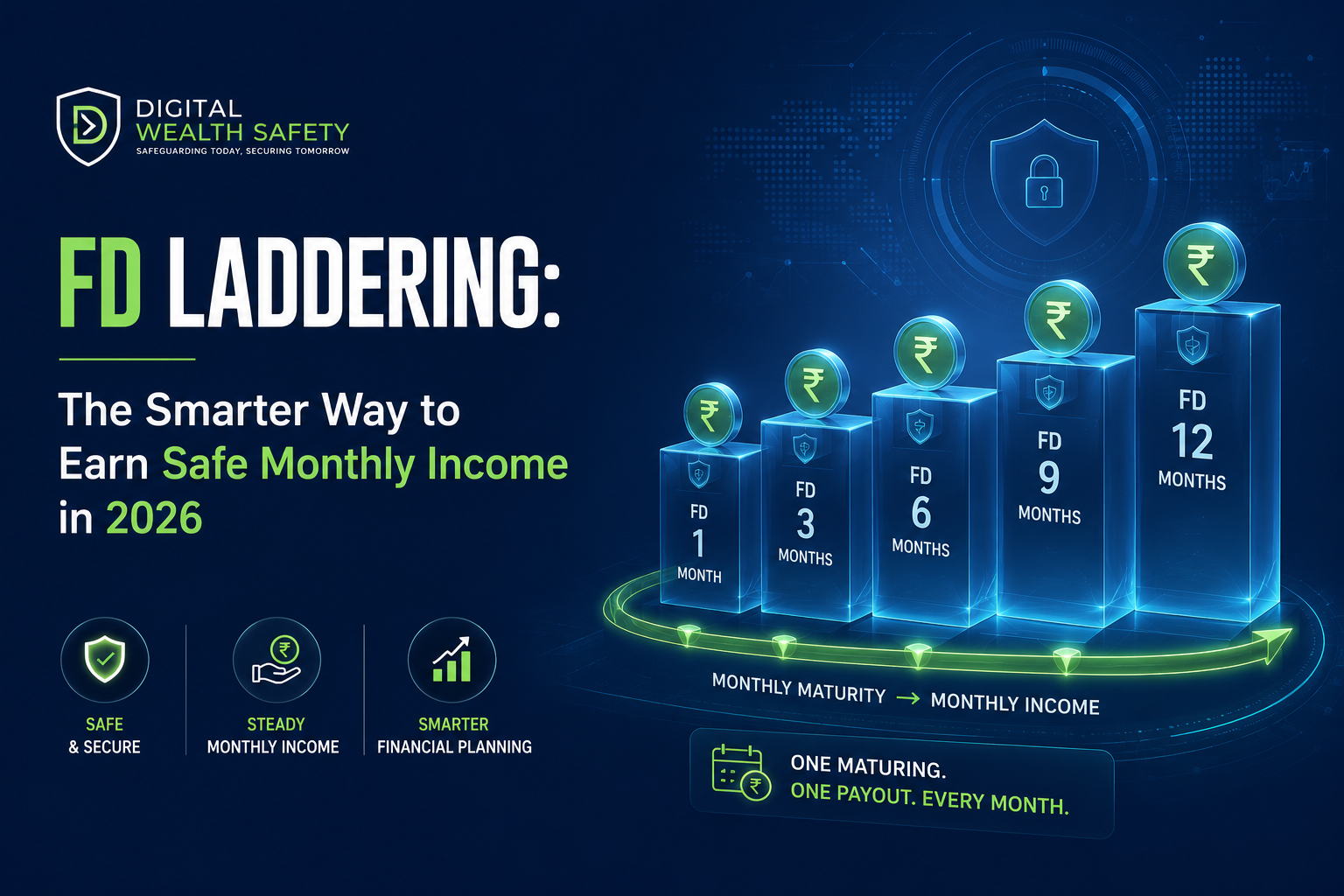
Laddering simply means splitting your total investment across multiple FDs with staggered maturity dates. Instead of one Rs. 25 lakh FD, you create five Rs. 5 lakh FDs maturing in year 1, year 2, year 3, year 4, and year 5 respectively.
As each FD matures, you reinvest the principal into a fresh long-term deposit at whatever rate is available then. The result is a rolling cycle of maturities that gives you regular access to cash, exposure to current interest rates, and no single point of lock-in failure.
Think of it like a staircase. Each step (one FD) matures at a different time. When you reach the top step, you build a new one at the bottom and keep climbing — indefinitely. Your money is always working, always accessible at least once a year, and always capturing the best available rate at reinvestment.
How a 5-Rung FD Ladder Works: A Real Example
Here is a classic 5-year FD ladder on a Rs. 25 lakh corpus. Each rung matures one year after the last, with progressively higher rates rewarding the longer commitment:
| FD Rung | Amount | Tenure & Rate | Annual Interest | Matures |
|---|---|---|---|---|
| FD 1 | Rs. 5 Lakhs | 1 year @ 7.0% | Rs. 35,000 | Year 1 |
| FD 2 | Rs. 5 Lakhs | 2 years @ 7.25% | Rs. 36,250 | Year 2 |
| FD 3 | Rs. 5 Lakhs | 3 years @ 7.5% | Rs. 37,500 | Year 3 |
| FD 4 | Rs. 5 Lakhs | 4 years @ 7.5% | Rs. 37,500 | Year 4 |
| FD 5 | Rs. 5 Lakhs | 5 years @ 7.75% | Rs. 37,500 | Year 5 |
| TOTAL | Rs. 25 Lakhs | Blended avg ~7.40% | Rs. 1,85,000/yr | ~Rs. 15,417/mo |
Every year, one FD matures. You take the interest as income (or reinvest it), then roll the principal into a fresh 5-year FD at the best available rate. Over time, all your FDs migrate to the long end — capturing higher rates — while one always matures each year for liquidity.
Compare this to parking the full Rs. 25 lakhs in a single 1-year FD at 7%: you earn Rs. 1,75,000/year, but if rates drop at renewal, your entire corpus reprices at the new lower rate in one shot. With a ladder, only one-fifth of your corpus reprices each year.
Getting Monthly Income: The Interest Payout Method
Most banks offer a monthly interest payout option on FDs. Instead of compounding, the bank credits interest directly to your linked savings account each month — on the same date, like clockwork. The effective yield is marginally lower than the cumulative option, but for retirees, that predictable monthly credit is worth far more than the small yield difference.
Four Steps to Set It Up Properly
Step 1
Select this option when booking each FD. The interest credit will hit your linked savings account on the same date every month.
Step 2
This avoids concentration risk and spreads maturity dates for smoother, more diversified cash flow.
Step 3
If your total income is below the taxable threshold, this form stops TDS deduction at source. Form 15G is for those under 60; Form 15H is for senior citizens.
Step 4
Roll the maturing FD into the longest tenure available — keeping the ladder intact and capturing the best current rate.
Senior citizens (above 60) typically receive an additional 0.25%–0.5% over the regular FD rate at most banks and NBFCs. Always check the senior citizen rate before booking — it adds up meaningfully over a full ladder cycle.
FD Ladder vs. the Alternatives: Honest Pros and Watch-Outs
No strategy is perfect. Here’s an honest look at what FD laddering does well and where you need to be aware of the limits:
| ✔ Pros | ⚠ Watch-Outs |
|---|---|
| Zero market risk — principal fully guaranteed by the bank | Interest is fully taxable at your income slab rate |
| Regular monthly income via interest payouts | No inflation-beating potential — real returns can be thin in high-inflation years |
| One rung matures every year — built-in liquidity without breaking any FD | Premature withdrawal attracts a penalty of 0.5%–1% |
| Captures rising rates on reinvestment — not stuck at one old rate | Rates can fall too — reinvestment risk exists at each rung |
| DICGC insurance covers up to Rs. 5 lakh per bank | Better suited for stability than long-term wealth growth |
The Tax Angle You Cannot Afford to Ignore
FD interest is added to your total income and taxed at your applicable slab rate. There’s no special treatment here — it is ordinary income. If your annual FD interest across all banks crosses Rs. 40,000 (Rs. 50,000 for senior citizens), the bank will deduct TDS at 10% before paying you.
A few moves that can keep your tax bill in check:
- File Form 15G (if you’re below 60) or Form 15H (if you’re 60 or above) if your total income is below the basic exemption limit. This prevents TDS deduction at source entirely.
- Spread your FDs across 2–3 banks to keep per-bank interest below the TDS threshold where possible.
- Under the New Tax Regime (the default from 2026), the basic exemption limit is Rs. 3 lakh. The higher senior citizen exemptions under the old regime no longer apply as default — factor this into your planning.
- If you also hold PPF or tax-free bonds, structure your withdrawals to stay within your slab boundary and avoid unnecessary bracket creep.
Where FD Laddering Fits in Your Broader Retirement Plan
An FD ladder works best as the stable income layer of a larger, well-diversified retirement portfolio — not as a standalone strategy. Think of it as the foundation that keeps the lights on, while equity mutual funds and government schemes do the heavy lifting for growth and inflation protection.
- Allocate 30–40% of your total corpus to the ladder — enough to cover 3–5 years of living expenses from maturity proceeds alone.
- Keep 5–10% in liquid funds or a savings account for short-term needs so you never have to break an FD at a penalty.
- Treat the longest-tenure rung (5 years) as your anchor — highest rate, longest compounding window, reinvested automatically each cycle.
- Review the ladder annually. If rates rise sharply, consider adding a rung or shifting more corpus to longer tenures to lock in the gains.
Pair your FD ladder with equity mutual funds for inflation-beating growth, and SCSS or PMVVY for additional guaranteed income. Together, these three layers cover predictable income, growth, and stability — the full picture.
Pair your FD ladder with equity mutual funds for inflation-beating growth, and SCSS or PMVVY for additional guaranteed income. Together, these three layers cover predictable income, growth, and stability — the full picture.